


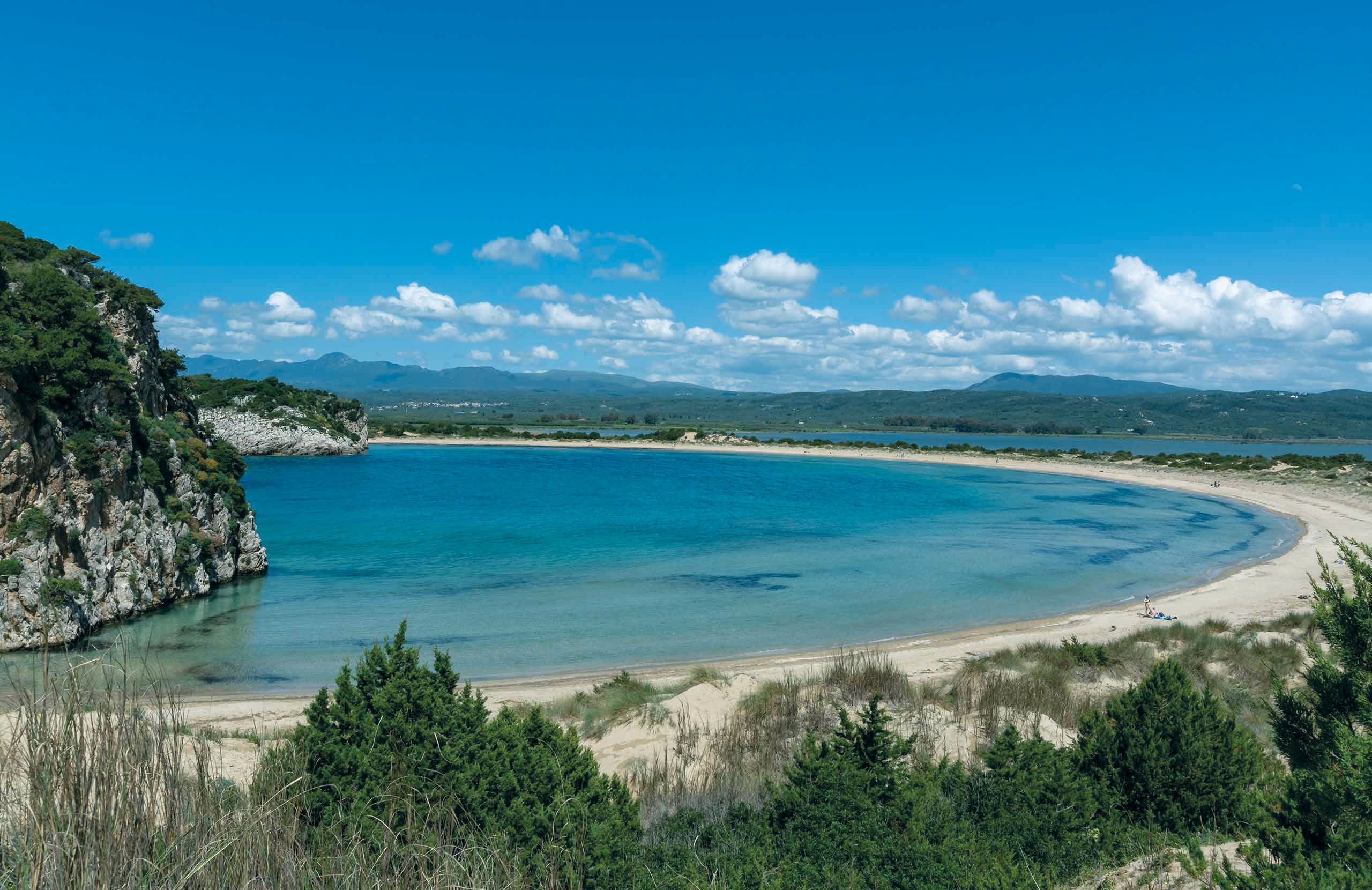


Voidokilia is a sandy bay on the west coast of Messenia, in the Peloponnese, a short drive north of Pylos. Seen from above, the beach curves in an almost perfect half circle, like the Greek letter omega (Ω). The sand is fine and pale, and the water inside the bay is shallow and clear. Behind the beach, a strip of high sand dunes separates it from the Gialova Lagoon, a wetland where more than 250 bird species have been recorded. The beach, the dunes and the lagoon are part of a Natura 2000 protected area.
Two hills close the bay at its ends. On the southern hill stand the walls of Old Navarino Castle, built by the Franks in the 13th century. Below them is Nestor’s Cave, a large cave with a triangular opening that can be seen from the beach. On the hill at the northern end is a Mycenaean tholos tomb, known as the Tomb of Thrasymedes after a son of King Nestor. Voidokilia is thought to be the “sandy Pylos” of Homer’s Odyssey, where Nestor welcomed Telemachus. The remains of Nestor’s own palace are inland, at the Palace of Nestor.
Voidokilia is less than half an hour by car from Pylos. The usual way is through the village of Petrochori, from where a dirt road leads to a parking area at the north end of the beach. You can also park at the far end of Divari beach, west of the village of Gialova, and walk along the lagoon and over the dunes to the south end of the bay, about fifteen minutes away.
There are no sunbeds, umbrellas or canteens on the beach, so bring shade and water. The bay is part of a protected area: keep to the paths over the dunes, take your rubbish with you, and leave sand and shells where they are. A steep path from the south end of the beach climbs to Nestor's Cave and Old Navarino Castle. The castle has open cisterns and visits are not always allowed, so check before you go.