


Antiparos is a small island in the Cyclades, separated from Paros by a channel only a few hundred metres wide. The ferry across takes seven minutes.
Its one town, Chora, grew around a Venetian castle of 1440 — not a fortress on a hill, but a square of houses built wall to wall, with a single gate. People still live in them.
The island has two other things that bring visitors. In the middle, a cave with stalactites that people have been climbing down into, and writing their names inside, for more than two thousand years. And off the southwest coast, on an uninhabited islet, one of the most important archaeological excavations in the Cyclades.
The beaches are sandy almost everywhere.
History & Culture
The Kastro
In 1440 a Venetian named Giovanni Loredan married Maria Sommaripa, whose family ruled Paros, and took possession of Antiparos. The island was almost empty. He paid to bring people to it, and he built them a castle to live in.
It is not a castle in the usual sense. Twenty-four two-storey houses were built as one continuous block, in a square, and their outer walls — three metres thick, with no balconies and no large windows — were the defensive wall. There was one way in: a Gothic gateway on the south side, which is still there. A tower stood in the middle, and its base survives.
This is one of the best examples in the Aegean of the fortified settlements the Venetians built across the Cyclades. Ownership passed to the Pisani family in 1480, the pirate Barbarossa looted the island in 1537, and the Ottomans took it in 1566.
Despotiko
Across the water from the village of Agios Georgios lies the uninhabited islet of Despotiko.
Test trenches were dug there in 1997, and systematic excavation began in 2001. What came out of the ground was a large sanctuary of Apollo, founded and run by the city of Paros. In its size and its layout it is unlike any other sanctuary in the Cyclades except Delos.
Since 2014 the buildings have been slowly rebuilt using their own fallen stone. The temple and the ceremonial dining hall were restored first. Work on a third building was almost finished in 2025.
The excavation is still going on every summer, and you can walk up to it.


Nature & Outdoors
The Cave of Antiparos is on the hill of Agios Ioannis, in the south of the island. A small chapel stands at the entrance.
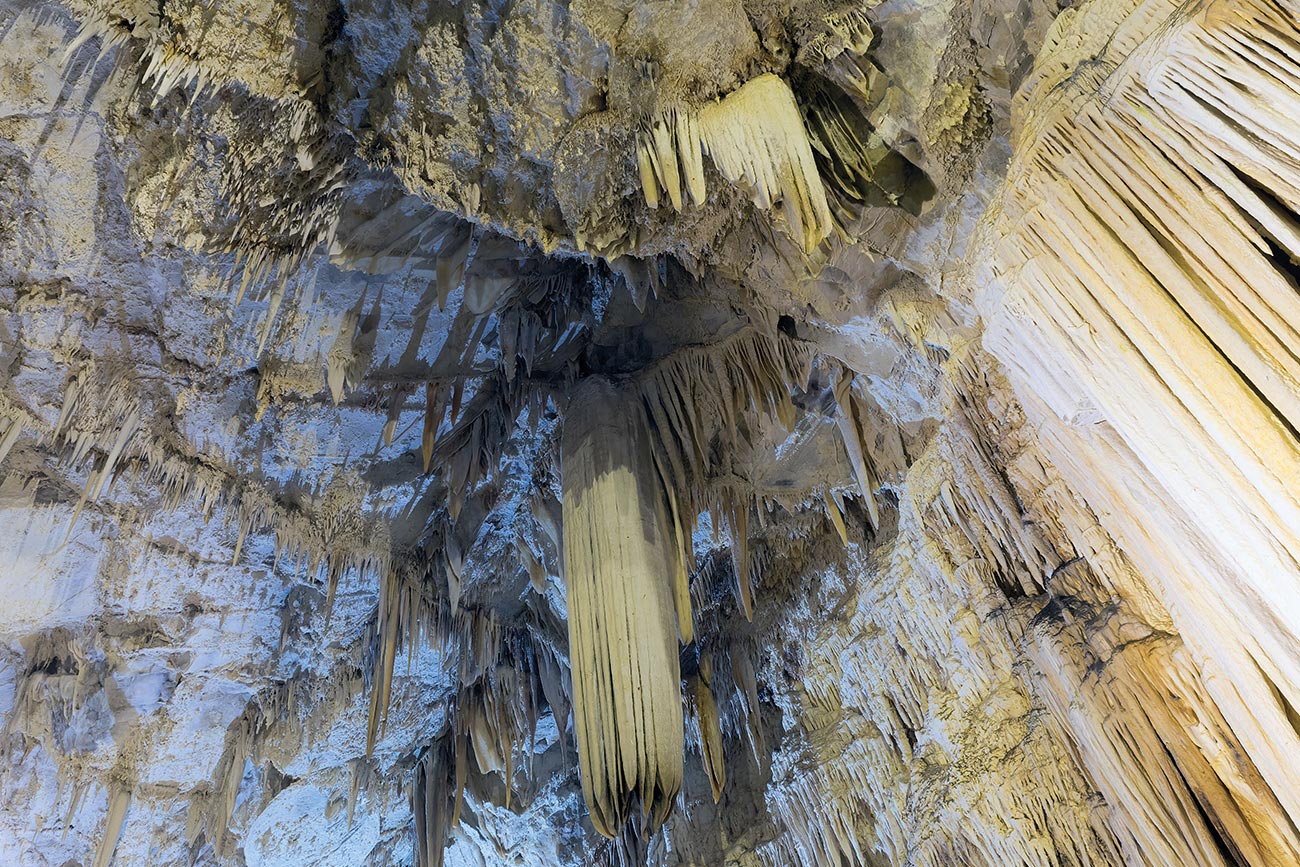
You go down 411 concrete steps into three chambers, one below the other, reaching about 85 metres below the surface. There are stalactites and stalagmites throughout, lit since 2009 by LED lighting.
Four centuries of visitors
What makes this cave different from other caves is that people kept leaving their names in it.
Inscriptions on the walls suggest it was known in antiquity. One of them, at the entrance, was read in the nineteenth century as a list of Macedonian generals who had plotted against Alexander the Great and hidden here — though it more probably records ordinary visitors.
In December 1673 the Marquis de Nointel, the French ambassador to Constantinople, came to see the cave. On Christmas Eve he had it lit with a hundred candles and four hundred oil lamps, and a priest in his party celebrated Christmas Mass inside it, using a large stalagmite as an altar. A Latin inscription cut into the base of that stalagmite records the date.
King Otto and Queen Amalia came down in September 1840, and the lowest chamber is named after the inscription they left.



Beaches
Almost every beach on Antiparos is sand, and most of them shelve gently.
Psaraliki is really two beaches side by side, a kilometre south of Chora and reachable on foot. They are the busiest, with sunbeds, a beach bar and watersports.
Soros, about eight kilometres south, is the largest beach on the island, with trees for shade and tavernas above it. The water deepens quickly a few metres from the shore, so it is less suitable for small children than it looks.
Glyfa, on the east coast, is organised and has a windsurfing school.
Sifneiko faces west, five minutes' walk from the square, and looks across to Sifnos. It is the sunset beach.
Agios Georgios, in the south, has fine sand, tavernas, and a view across to Despotiko.
Livadia, on the west coast about seventeen kilometres out, is golden sand with no shade at all and almost nobody on it. Faneromeni, Kako Rema and the small coves of the south coast are the same: bring water, an umbrella and food.
The camping beach north of the town has been used by naturists since the 1970s, when Antiparos first became known for that.


Activities
The channel between Paros and Antiparos is shallow and gets steady wind, and it is one of the better places in the Cyclades for windsurfing and kitesurfing. Most of that activity is based on the Paros side, but there is a windsurfing school at Glyfa on the east coast, and equipment to rent at Psaraliki.
Boat trips are the other thing to do here. Day boats go round the island with swimming stops, and small boats run from Agios Georgios across to Despotiko in about ten minutes. On calm mornings at low tide you can wade across the sandbank instead. Kayak trips go along the south coast to sea caves that boats cannot enter.
Where to Stay
Prices shown per night for a sample 3-night stay. Rates and availability vary by season — select your dates for live pricing.
Practical information
Getting there
Antiparos has no airport and no direct ferry from Athens. You travel to Paros first, by ferry from Piraeus or Rafina, or by domestic flight. From Paros there are two crossings. From Pounta, on the west coast, the ferry takes seven to ten minutes, runs about every half hour from early morning until late at night, and takes cars. From Parikia, the capital of Paros, a passenger boat takes about thirty minutes and runs roughly ten times a day.
Getting around
The island is small and mostly flat, and a bicycle or a scooter is enough for most of it. There is a bus from Chora to the cave and to some beaches in summer, but not many. A car helps for the far south and for Livadia, and the last few kilometres to some beaches are dirt road. From Chora you can walk to Psaraliki and Sifneiko.
When to go
The season is May to October. June and September are the best months: everything is open, the sea is warm, and the town is not full. July and August are busy, and accommodation needs booking well ahead. In winter the island is very quiet and most places close.
Good to know
The cave means 411 steps down and 411 back up, and there is no other way out — do not start if you are not sure you can climb back. It is cool inside; take something with sleeves. Check current opening hours and the entrance fee before you go.
For Despotiko, the site is free but there are no facilities of any kind: no shade, no water, no toilets. Boats leave from Agios Georgios. There are only a few explanatory signs, and the excavation team gives occasional guided visits in summer.
Antiparos— been there?Tell others what you saw.
A photo and two lines are enough.
