Archanes
- Ancient Landmarks, Traditional Villages, Wineries
- Geo Area: Crete

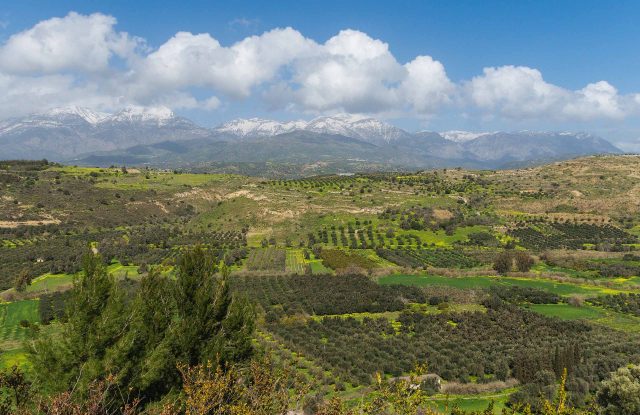
Archanes is a village in the hills of Crete, about 16 kilometres south of Heraklion, at 380 metres above sea level. Vineyards and olive groves surround it, and Mount Juktas rises directly above.
Two things make it worth the short drive from the city.
The first is the village itself. Its houses have been restored over the last thirty years, painted in strong colours, with their power cables buried underground. In October 2000 the European Union gave Archanes its first prize for integrated and sustainable development.
The second is what lies under and around it. This was a major Minoan centre — a palace, a cemetery used for more than a thousand years, a temple on the mountain, and the peak sanctuary above them all.
History & Culture
Archanes controlled the fertile valley south of Knossos, and it was rich. Its Minoan sites are spread around the village rather than in one place.
The palace
Arthur Evans believed there had been a summer palace of the kings of Knossos here, but he never found it. Yannis Sakellarakis proved him right in 1964, when he uncovered a palace complex in the Tourkogeitonia neighbourhood of the village.
What has come to light so far includes the core of the building, a theatre area, an archive of Linear A tablets, shrines, a monumental entrance, living quarters, cisterns and a water system. Parts of it are still under modern houses.
The cemetery at Fourni
Fourni, on a low ridge outside the village, was in use for more than a thousand years — from about 2400 to 1200 BC. It is one of the most complete prehistoric cemeteries known anywhere in the Aegean.
You can walk to it from the village along the old Minoan path, starting near the old primary school.
Anemospilia
At the northern end of Mount Juktas stands a small two-storey building of the seventeenth century BC, destroyed by an earthquake a few decades after it was built.
Four rooms have been excavated. What was found inside them — the position of the skeletons and the objects with them — led the excavators, supported by anthropologists and forensic scientists, to conclude that a human sacrifice was taking place when the building collapsed. This remains one of the most discussed finds in Minoan archaeology.
Vathypetro
South of the village, the Minoan house at Vathypetro is large enough that some call it a small palace. It contains one of the oldest known wine presses in Crete, from around 1600 BC, and an olive press beside it.
The village that rebuilt itself
The Archanes a visitor sees today is the result of work that began in 1992. Old houses were restored rather than replaced, and painted in strong colours — deep blue, ochre, dark red. The electricity cables were buried, which is rare in Greece and which is why photographs of the village have no wires across them.
In October 2000 the village won first prize in a European Union competition for integrated and sustainable development of excellent quality, and the University of Crete gave it an environmental award the following year.
A small archaeological museum on the square holds finds from the Minoan sites nearby, and a restored olive-oil factory in Tourkogeitonia shows how oil was made before machines.
Nature & Outdoors
Mount Juktas rises to 811 metres directly above the village. Seen from the north it has the profile of a face lying on its back, and in antiquity people said it was the tomb of Zeus.
Near the summit are the remains of the Minoan peak sanctuary, the most important one on Crete. At the very top stands the chapel of Afentis Christos, with a view across the whole Heraklion plain on one side and towards the south coast on the other.
Marked paths connect the village with the summit, the peak sanctuary and Anemospilia, and a second path descends the eastern side of the mountain back to the ring road. The walking is best in spring and autumn.
Food & Drink
Archanes has given its name to two protected designations of origin: one for wine and one for olive oil.
PDO Archanes wine is red and dry, made by blending two Cretan grapes — Kotsifali, which gives light colour, strong aromas and high alcohol, and Mandilaria, which is dark, tannic and sharper. Together they make a balanced wine with flavours of ripe dark fruit and dried herbs. The zone is small: only three wineries make it.
The link between this valley and wine is very old. The press at Vathypetro was working three and a half thousand years ago.
PDO Archanes olive oil comes from the same ground, in a zone that runs from just south of Knossos down to Vathypetro.
Around the square you will find the standard Cretan dishes — dakos, kalitsounia, slow-cooked lamb and goat — and the ingredients come from close by.
Where to Stay
Prices shown per night for a sample 3-night stay. Rates and availability vary by season — select your dates for live pricing.
Practical information
Getting there
Archanes is about 16 km south of Heraklion, roughly twenty-five minutes by car. It is a short detour from Knossos, which is on the same road. Buses run from Heraklion several times a day. Heraklion airport is about 20 km away, which makes Archanes workable as a base for the first or last night of a trip.
Getting around
The village is small and best seen on foot. The archaeological sites are not: Fourni is a walk or a short drive, Vathypetro is a few kilometres south, and Anemospilia and the peak sanctuary are up the mountain. A car is needed if you want to see them all in a day, and walking shoes if you plan to go up Juktas.
When to go
April to June and September to October are the best months. The village sits high enough to be comfortable in summer, but the archaeological sites and the mountain paths have no shade. Spring brings wild flowers on Juktas; autumn brings the grape harvest.
Good to know
Check the opening hours of each archaeological site separately before you plan a route — they do not all keep the same days or times, and some are open only in the morning. Take water and a hat for Juktas and for Fourni; there is no shade at either. The village square fills at weekends with visitors from Heraklion, so a weekday is quieter.