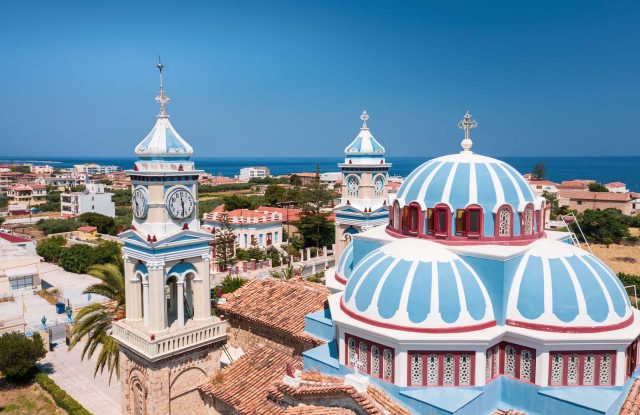
Chios lies in the North and East Aegean, close enough to the Turkish coast to see the buildings on it. It is the fifth largest Greek island, and it is unlike its neighbours.
The reason is a resin called mastic. The shrub that produces it grows around the Mediterranean, but only in the south of Chios does it give resin in useful quantity. That single fact shaped the island: medieval villages were laid out as small fortresses to guard the crop, and the traditional way of growing it is on the UNESCO list of intangible cultural heritage.
Chios also has an eleventh-century monastery with some of the finest Byzantine mosaics in Greece, and an abandoned village on a cliff edge that has stood empty since 1822.
History & Culture
Mastic
The mastic shrub is a slow-growing evergreen, two or three metres tall, which reaches full size only after forty or fifty years.
In summer the growers cut small wounds into the bark and the trunk. The work is called kentima, embroidering. The resin runs out over the following weeks and hardens into drops on the cleaned ground below, and it is then collected by hand, cleaned by hand and sorted by hand.
Chios mastic has been a protected designation of origin since 1997. In 2014 UNESCO added the traditional knowledge of growing it to its list of intangible cultural heritage. In 2015 the European Medicines Agency recognised it as a herbal medicine.
Twenty-four villages in the south of the island are attached to the crop, through cooperatives that go back to a growers' union founded in 1938. A Mastic Museum stands among them, built on a working grove, and it explains the whole process from the shrub to the finished product.
Nea Moni
Nea Moni stands at 670 metres in the middle of the island, twelve kilometres from the town. It was founded around 1042, paid for by the emperor Constantine IX Monomachos, and its main church is an early example of the octagonal type.
Its mosaics are among the three best-preserved Byzantine collections in Greece, and the monastery has been a UNESCO World Heritage Site since 1990.
1822
In 1822 the Ottomans put down a rising on Chios with extreme violence. Thousands were killed and thousands more sold into slavery, and the island did not recover for generations. The event became known across Europe, above all through Delacroix's painting of it.
Nea Moni was looted and burned. The monks, and the many people who had taken refuge inside the walls, were killed in the precinct. Their bones are kept in a crypt in the cemetery chapel outside the wall, and you can see them.
Anavatos, an eleventh-century village on the edge of a cliff in the middle of the island, was destroyed in the same year and has been empty ever since. About four hundred stone houses are still standing, and you can walk into them.


Villages & Inland
The mastic villages
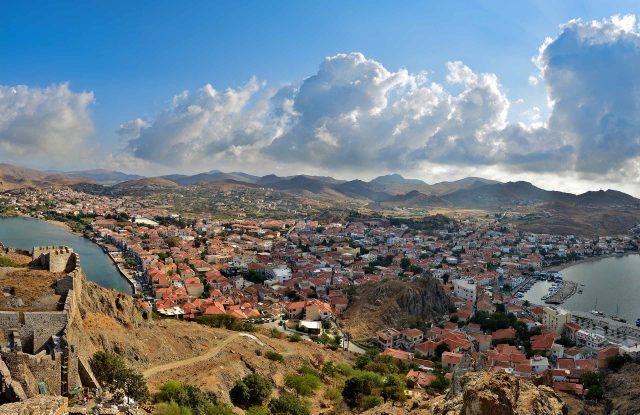
The mastichochoria were laid out from the fourteenth century under Genoese rule, to house the people who worked and guarded the mastic crop. They were built as fortresses. The outer houses formed a continuous defensive wall with no openings on the outside, a single gate led in, a tower stood in the middle, and the lanes between the houses were narrow and often roofed over.
Mesta, in the southwest, is the most complete. Its plan is a closed shape with a maze of lanes inside, and people still live in it.
Pyrgi is the painted village. The fronts of its houses are covered in black and white geometric patterns called xysta: the wall is plastered with dark sand, whitewashed, and then scraped through to bring the black back out. Squares, triangles, diamonds, flowers and birds cover almost every surface.
Olympi keeps its twenty-metre central tower and its underground storerooms.
The earthquake of 1881 damaged many of the others, which is why these three stand out.
Kampos
Just south of the town, Kampos is something else entirely: a flat area of walled citrus estates, laid out by wealthy Genoese and later Greek families. Behind high stone walls are mansions, gardens, wells with hand-turned water wheels, and orange and lemon trees. Some are hotels now, some are private, and the lanes between the walls are quiet enough to walk.
The north
The north of the island is emptier and rougher. Volissos climbs a hill under a Byzantine tower and the remains of a medieval castle. Avgonyma is a small stone village with a view west over the sea, and Kardamyla, on the northeast coast, is full of shipowners' houses.


Nature & Outdoors
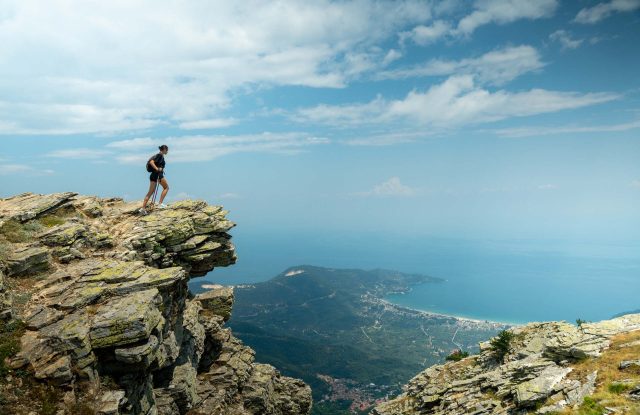
Mount Pelinaio, in the north, is the highest point on the island and the walking there is the best on Chios.
In the south, the Cave of Olympi, also called the cave of Sykia, is open to visitors and has an unusual density of formations for its size.
Fires have passed through parts of the island in recent years, including the slopes on the road up to Nea Moni, most recently in June 2025. The mastic groves in the south were not lost, and the villages were not damaged, but some of the wooded ground in the centre and west looks different from older photographs.

Beaches
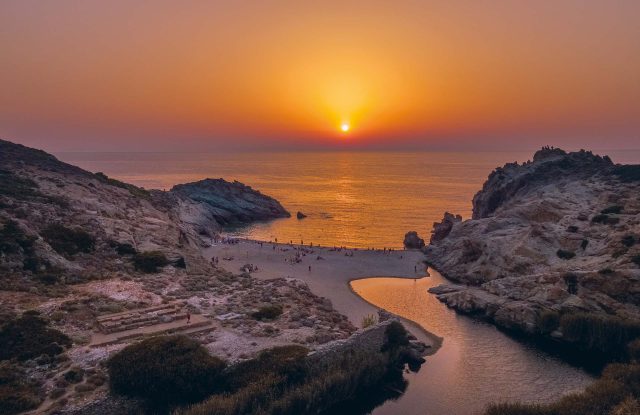
Chios has more than ninety beaches, and most of them are pebble rather than sand. The water is usually deep close in and very clear.
Mavra Volia, below Emporios in the south, is the one people come for: a long beach of black volcanic pebbles below dark cliffs, with water that turns deep blue almost at once.
Elinda, on the west coast near Avgonyma, is white pebbles in a closed bay. Vroulidia, at the southern tip, is small, pale and reached down a steep path.
For sand, go to Karfas, close to the town and the most organised beach on the island, or Komi on the southeast coast, which has dunes behind it, or Lithi in the west, which is shallow and easy with children.


Food & Drink
Mastic runs through everything. It goes into ypovrychio, the white spoon sweet served in a glass of cold water, into biscuits, ice cream, liqueur, chewing gum and bread. It is also used in savoury cooking, in small amounts.
The island's own spirit is souma, distilled from figs rather than grapes in some villages and drunk cold.
Chios makes a hard sheep's cheese and, in the mastic villages, cured pork and sun-dried tomatoes — you will see the tomatoes hanging in strings on the house fronts in Pyrgi in late summer.
The citrus of Kampos becomes spoon sweets and liqueur, and the island produces good olive oil and thyme honey.

Where to Stay
Prices shown per night for a sample 3-night stay. Rates and availability vary by season — select your dates for live pricing.
Practical information
Getting there
Chios has an airport three kilometres from the town, with daily flights from Athens all year and connections to Thessaloniki and several other Aegean islands. Ferries from Piraeus take about seven and a half to nine and a half hours, usually overnight, with daily sailings in summer and fewer in winter. There are also ferries from Lavrio, and in summer from Kavala and Thessaloniki. A second island port at Mesta serves some routes. Chios is also connected all year with Çeşme in Turkey, a crossing of about thirty minutes.
Getting around
You will need a car. Chios is large — the mastic villages are around thirty kilometres from the town, Volissos is nearly forty, and Nea Moni is twelve kilometres up a mountain road. Buses connect the town with the main villages but not often, and they are not built around sightseeing. Roads are generally good, but narrow and winding in the mountains and in the north.
When to go
May, June, September and October are the best months. Easter is worth planning around: at Vrontados, north of the town, two parish churches fire thousands of homemade rockets at each other's bell towers on the night of the Resurrection. The mastic harvest runs through late summer. July and August are hot and the beaches fill, but Chios never becomes crowded the way the Cyclades do.
Good to know
Check the opening hours of Nea Moni before driving up; it closes in the middle of the day. Modest dress is required. Anavatos is unfenced and unrepaired — the ground is loose, there are open drops, and there is no shade or water. The mastic villages are lived in, so keep noise down in the lanes. Buy mastic from the growers' cooperative shops rather than from souvenir stands.