Franchthi cave
- Ancient Landmarks, Caves
- Geo Area: Peloponnese

The Franchthi Cave opens onto the bay of Koilada, in the southeastern Peloponnese, across the water from the fishing village of the same name.
It is one of the most important prehistoric sites in Europe, for one reason: people used it, on and off, for around thirty thousand years.
The Ministry of Culture dates the main phases of occupation to the Upper Palaeolithic, from about 40,000 to 10,000 BC; the Mesolithic, from 9,000 to 7,000 BC; and the Neolithic, from 7,000 down to about 3,000 BC, when the cave was finally abandoned. Very few sites anywhere show a sequence like it, and almost none in Greece.
What the layers show
In the earliest phases small groups of hunters passed through, using flint tools to kill and butcher wild horses and deer.
From about the tenth to the eighth millennium BC whole families were living here, gathering plants, fishing, and making more complex tools.
Then something changed. The people of Franchthi stopped only hunting and gathering and began to farm, around 7,000 BC — and the settlement spread out of the cave and onto the shore in front of it. The excavation recorded that transition in a single continuous sequence of layers, which is why the site matters to archaeologists far beyond Greece.
The obsidian
Among the stone tools were blades of obsidian from the island of Melos, and the earliest of them date to around 13,000 BC.
Melos is a hundred and fifty kilometres away across open water. Somebody was building boats and crossing the Aegean in them at a date far earlier than anyone had assumed, and Franchthi is where the evidence for it came from.
The burial
A shallow grave in the cave held the oldest complete human skeleton found in Greece — a man of about twenty-five, roughly 1.58 metres tall, buried in the Mesolithic period.
Burials of that date are extremely rare anywhere. How he died is not settled: his skull carries injuries, and researchers have suggested both a fall or an animal and other explanations.
The finds from the excavation are in the Archaeological Museum of Nafplio.
What to see today
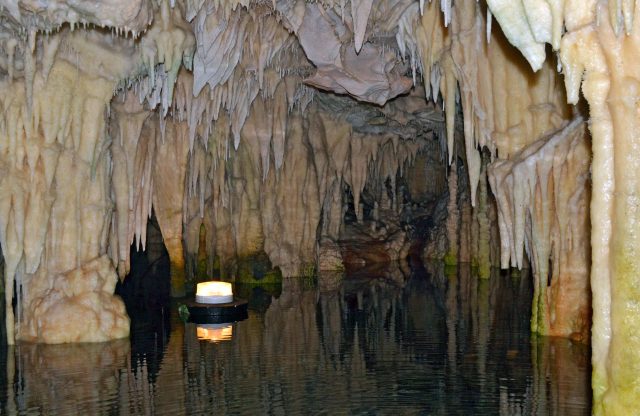
The cave is very large, with a wide mouth opening straight onto the sea and a chamber running back into the rock. Sections of the roof collapsed long ago, and the interior is not what it was when people lived here.
A footpath runs to it along the shore, about six hundred metres from the parking area, with signboards in Greek and English explaining the geology and the archaeology. The walk is easy and level but the surface is stony.
Standing at the mouth is the point of the visit. The sea is directly below now; when the first people used this cave, the shoreline was several kilometres further out and a broad valley lay in front of it.
Where to Stay
Prices shown per night for a sample 3-night stay. Rates and availability vary by season — select your dates for live pricing.
Practical information
Getting there
Franchthi is in the southeastern Argolid, about fifteen minutes from Kranidi and an hour and a half from Nafplio. From Athens it is around two and a half hours.
By car, take the road towards Kranidi and turn off for Fournoi and its beach. There is parking at the end of the road, on a small pebble beach, and the path starts there.
Boats also cross from Koilada, on the other side of the bay, which is the shorter way if you are already there.
Tickets and hours
The site is open ground with no gate, no ticket office and no fixed hours. The path and the interpretation panels are maintained but there is no staff.
How to visit
Allow about an hour, including the walk in each direction.
Combine it with the Archaeological Museum of Nafplio, where the finds from the cave are displayed. Seeing the tools and the carbonised seeds after standing in the cave makes far more sense of it.
Koilada, across the bay, is a working fishing village and the obvious place to eat afterwards.
Good to know
Wear closed shoes. The path is rocky and so is the cave floor.
There is no shade on the path and no water anywhere — bring your own in summer.
The interior is unlit and uneven, with fallen rock. Go carefully and do not climb on the excavated sections.
This is a place that rewards knowing what you are looking at. Without that, it is a large empty cave — which is exactly why the panels and the museum matter.
Franchthi cave— been there?Tell others what you saw.
A photo and two lines are enough.