Hersonissos
- Golf, Nightlife & Social Fun, Sandy Beaches
- Geo Area: Crete

Hersonissos is on the northern coast of Crete, about twenty-five kilometres east of Heraklion, and it is one of the largest resort towns in Greece.
It is built for holidays and makes no secret of it: a long seafront of hotels, bars and beach clubs, and one of the busiest nightlife scenes in the country through July and August.
Underneath it is an older place. The Romans had a harbour here with covered shipsheds and fountains with mosaic floors, and their fish tanks are still cut into the rock beside the modern quay — partly under water now, because the sea has risen about a metre since.
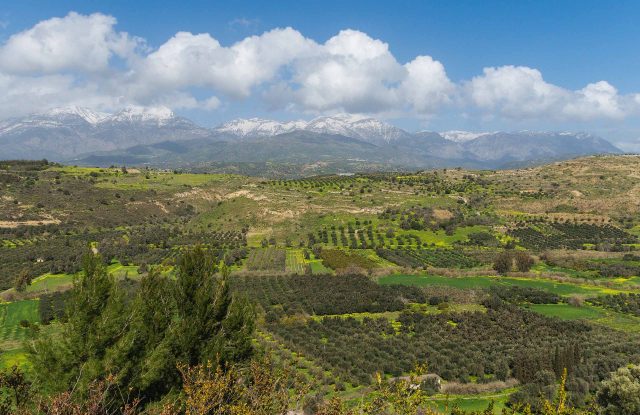
On the slope above the town, three older villages sit apart from all of it.
History & Culture
The Roman harbour
There has been a settlement here since Minoan times, helped by the shelter of the Kastri headland. In the Hellenistic period it served as the port of Lyttos, a powerful inland city, and it minted its own coinage with a ship's prow on it.
Its best years came under Rome. The harbour had jetties and roofed shipsheds, and the town had fountains with mosaic floors and small cascades running through them.
The most visible survival is the group of fish tanks cut into the rock at the water's edge — Roman tanks for keeping fish alive, studied by British archaeologists in 1955, who used them to calculate that the sea here has risen by about a metre since they were made. You can see them from the harbour front.
On the Kastri hill east of the small harbours are the remains of an early Christian basilica with mosaic floors, and there is a second at Agios Nikolaos.
Malia and the museum
Seven kilometres east, the Palace of Malia is the third largest Minoan palace on Crete, after Knossos and Phaistos. It sits on flat ground beside the sea and is far less visited than Knossos.
The Lychnostatis Open Air Museum, at the eastern edge of Hersonissos, reconstructs the working life of a Cretan household — the oil press, the still, the loom, the herb garden — on a site above the sea.
Villages & Inland
Three villages sit on the slope directly above the resort, and they are a different place entirely.
Koutouloufari and Piskopiano are stone-built, with narrow lanes, bougainvillea and tavernas in small squares looking down over the coast. Ano Hersonissos, higher again, is the largest and least visited.
They are two or three kilometres from the seafront and a ten-minute drive, and a great many people stay in them precisely to be out of the noise.

Beaches
The coast here is developed and organised almost end to end, and the beaches are the reason the town exists.
Star Beach, at the eastern end, is the well-known one: a beach club with a water park, watersports and music through the day.
Anissaras, west of the town, is sandy, calmer and shallower, and is the family choice.
Sarandaris, on the headland, is rockier, with small coves and clear water, and is the quietest of the three.
The town beach itself runs along the seafront and is busy from morning to night.

Activities
Nightlife
Hersonissos has one of the largest concentrations of bars and clubs in Greece, along the main seafront strip, and in July and August it runs late every night. This is a large part of why people choose it, and it is also why some people choose somewhere else.
Golf
The Crete Golf Club, a few kilometres inland, is an eighteen-hole championship course laid out across seventy-two hectares of hillside. It is the only golf course on Crete and it is open all year.
The aquarium
Cretaquarium, at Gournes about ten kilometres west, is one of the largest aquariums in Europe, with sixty tanks holding species of the Mediterranean. It is the standard wet-weather and small-children answer for this stretch of coast.
Where to Stay
Prices shown per night for a sample 3-night stay. Rates and availability vary by season — select your dates for live pricing.
Practical information
Getting there
Hersonissos is about 25 km east of Heraklion, twenty-five minutes by car on the national road, and roughly 20 km from Heraklion airport — closer to the airport than the city is.
Buses run frequently along the coast between Heraklion, Hersonissos, Malia and Agios Nikolaos, and they are cheap and reliable.
Getting around
The seafront is walkable end to end, and everything in the resort is on it.
The hill villages are two to three kilometres up and steep — a taxi or a car, not a walk. A car is worth having for Malia, the golf course, the aquarium and anywhere inland.
When to go
May, June, September and early October give the same sea with far fewer people. July and August are when the resort is at full volume, which is the point for some visitors and the problem for others.
Most of Hersonissos closes from November to April.
Good to know
This is a mass-market resort, not a Cretan town that happens to have visitors. If that is what you want, it does it well and cheaply. If it is not, the hill villages above it or Agios Nikolaos further east are better bases.
The Roman fish tanks are unmarked and easy to walk past. They are at the western end of the harbour, at the waterline.
Malia palace has almost no shade. Go early.