Hydra
- Scuba Diving, Traditional Villages, Yacht Marinas
- Geo Area: Saronic Islands

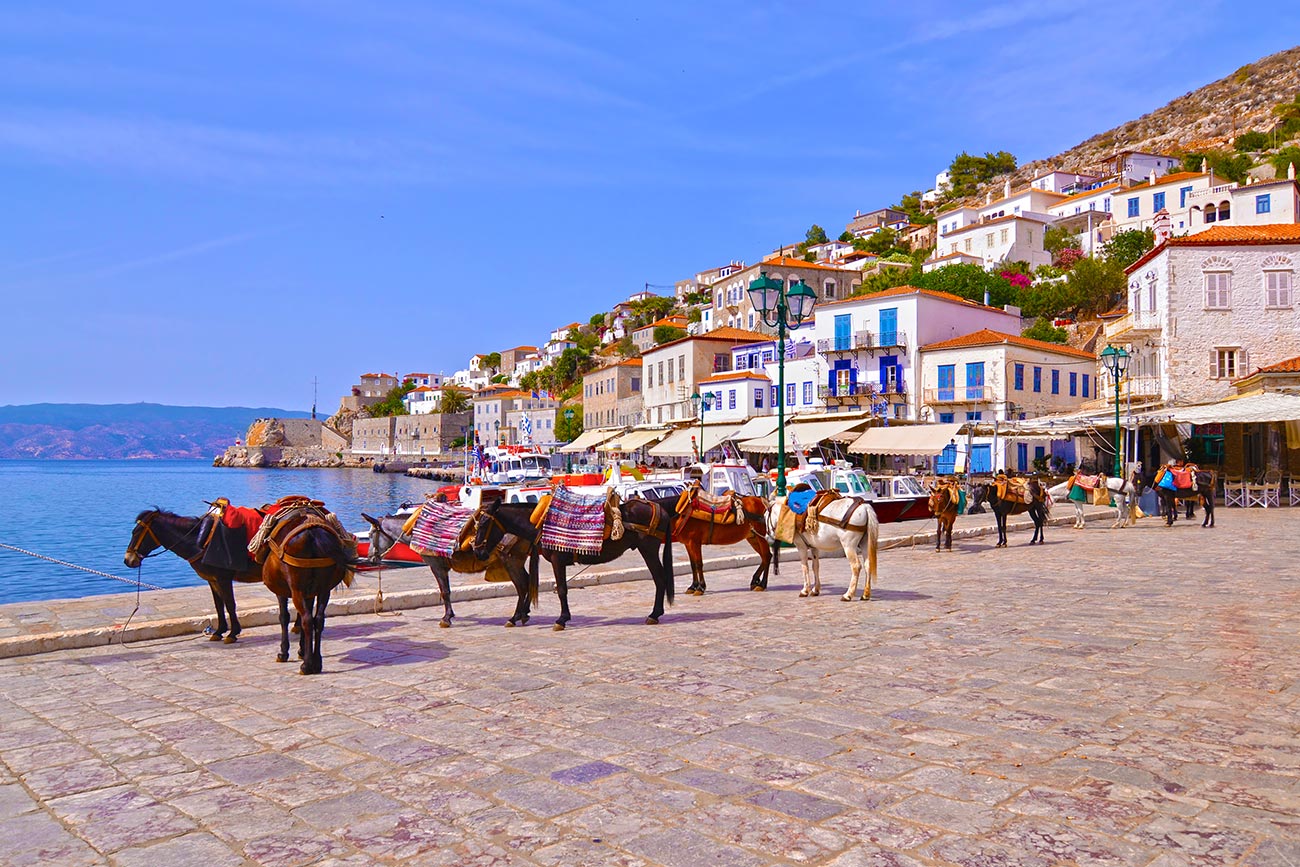
Hydra is a rocky island in the Saronic Islands, about two hours from Piraeus, with one town built in a steep amphitheatre around its harbour.
There are no cars on it. A presidential decree of the 1950s banned motor vehicles to protect the town, and the ban has held ever since — the only exceptions are the fire engine, the ambulance and the refuse lorry. Everything else moves on foot, by donkey and mule, or by water taxi.
The stone mansions around the harbour were built by shipowners. In 1821 the island sent 120 ships and around 5,400 sailors to the Greek revolution, and the admirals who commanded the Greek fleet came from these houses.
Since the 1950s it has also been a place artists come to, and some of them stayed.
History & Culture
The fleet and the revolution
Hydra is bare rock with almost no farmland, so its people went to sea. By the end of the eighteenth century they had built one of the largest merchant fleets in the eastern Mediterranean, and by 1821 the island was rich.
When the revolution began, the shipowners put that fleet and their own money into it. Hydra contributed 120 ships and about 5,400 sailors — and it produced the men who led the naval war: Andreas Miaoulis, who commanded the Greek fleet, along with the Koundouriotis, Tombazis, Sachtouris, Tsamados and Kriezis families.
The mansions
The captains' houses stand in tiers above the harbour, built of grey stone with high walls and enclosed courtyards, and several are open.
The Lazaros Koundouriotis mansion belonged to the man who financed much of the revolution, and it is now a branch of the National Historical Museum. The Pavlos Koundouriotis mansion, higher up among the pines, belonged to the admiral who became the first President of the Second Hellenic Republic, and covers the island's more recent past.
The Historical Archives Museum, on the harbour front, holds the documents, weapons, ship models and portraits of the revolutionary period.
The artists
From the 1950s Hydra became a place writers and painters came to and often did not leave. Leonard Cohen bought a house here in the 1960s and kept it for the rest of his life. Henry Miller wrote about the island, Patrick Leigh Fermor visited repeatedly, and the Greek painter Nikos Hatzikyriakos-Ghikas had a house here.
That has left a real gallery scene, and exhibitions run through the summer
Nature & Outdoors
The island is limestone, dry and steep, with almost no roads — which means the old stone paths between the town, the monasteries and the coves are still the way people move.
The walk up to the Monastery of Profitis Ilias, on the slopes above the town, takes about an hour and climbs steeply. From there a path continues to Mount Eros, the highest point, with the whole Saronic Gulf below.
Other paths run west along the coast to Kamini and Vlychos, and much further out to Episkopi and the western end of the island, which is empty.
There is no shade on any of them.
Beaches
Hydra has almost no sand. The coast is rock, and swimming here means concrete platforms, pebble coves and ladders into deep water — which is part of the island's character rather than a shortcoming.
Spilia, at the edge of the town, is rock and platforms with a bar, and it is where people swim between drinks.
Kamini and Vlychos, twenty and forty minutes west on foot along the coast path, are pebble and the most used.
Bisti and Agios Nikolaos, at the western end, are reached by water taxi and are pine-backed and quiet. Limnioniza, on the south coast, takes a long walk or a boat.
The water everywhere is deep and exceptionally clear.
Activities
Diving works well here because the water is deep close in and the rock drops steeply. A dive centre operates from the town, with equipment hire, guided dives, night dives and wreck dives.
Water taxis run all day from the harbour to the beaches and round the island, and they are transport rather than an excursion — for the western coves there is no other way.
The harbour is a standing stop for yachts on the Saronic route, and in summer it fills.
The Miaoulia festival in June commemorates Admiral Miaoulis, with a re-enactment in the harbour and fireworks.
Food & Drink
Hydra has no farmland to speak of, so the food comes from the sea and from the mainland opposite.
Amygdalota, soft almond sweets dusted with sugar, are the island's own and are sold in the bakeries around the harbour.
The tavernas cook fish, octopus and the standard Greek repertoire. The harbour front is the expensive stretch; the cooking is better in Kamini and in the lanes above the town.
Where to Stay
Prices shown per night for a sample 3-night stay. Rates and availability vary by season — select your dates for live pricing.
Practical information
Getting there
Hydra is reached only by boat. Hydrofoils and catamarans run from Piraeus several times a day, taking about two hours, and there are connections to Poros, Aegina and Spetses.
There is also a short crossing from Metochi, on the mainland opposite, which takes about twenty minutes — useful if you are driving, since you leave the car there.
Getting around
There are no vehicles. You walk, or you take a water taxi, or you hire a mule.
The town is built up a steep slope in stepped lanes, and everything above the harbour involves climbing. Luggage is carried up by mule or by porter with a handcart.
Water taxis run to the beaches and cost more than you expect, especially at night
When to go
May, June and September are the best months. July and August are very busy, and Hydra is a common day trip from Athens, so the harbour fills between eleven and five and empties afterwards.
Staying the night is a completely different experience from the day trip.
Weekends are busier than weekdays all year, because Athens is close.
Good to know
Wear proper shoes. The lanes are stone, stepped and steep, and this is not an island for wheeled suitcases.
Hydra is expensive by Greek island standards, particularly on the harbour front.
There is no shade on the paths and no water. Carry your own.
The town is a listed settlement and building is tightly controlled, which is why it looks as it does.