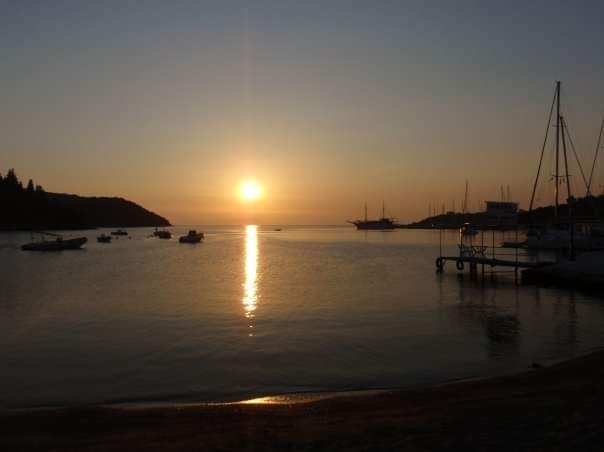
July and August are the busiest months at the port. Many families who live and work elsewhere in Europe drive home to Greece for the summer, and this is where they cross. Book ferries well ahead for those months.
Igoumenitsa
- Ferry Hubs, Rivers, Wetlands
- Geo Area: Epirus

Igoumenitsa is the capital of Thesprotia, on the Ionian coast of Epirus, directly opposite Corfu.
It is the second busiest passenger port in Greece, after Piraeus, and the closest Greek harbour to Italy. Around two and a half million people pass through it every year, along with a quarter of a million lorries, and for most of them it is the point where Greece begins or ends.
Very few of them stop. Behind the port is a small working town, a river delta that is one of the more important wetlands in western Greece, and the remains of a fourth-century BC city with its theatre still standing above the water.
TIP: Drag and drop "Pegman" onto zoomed map for a 360o photo view !
What travellers posted
Been here? A photo and two lines are enough.
History & Culture
Gitana
Twenty kilometres north, on a low hill above the Kalamas river, stood Gitana — the capital of the Thesprotian League and its political and religious centre from the fourth century BC.
The city was walled, with towers and gates, and its theatre sits on the lowest terrace, outside the walls, protected by its own outer wall and by the river below. It was built of white limestone from the start, and it looks straight out over the water.
Excavation has also uncovered the agora, temples, the prytaneion, houses, workshops, and a floor with the Vergina Sun worked into it.
The Archaeological Museum of Igoumenitsa, in the town, holds the finds from Gitana and from the other sites of Thesprotia.
The town
Igoumenitsa itself is not old in the way its surroundings are. It appears in the records as a harbour and a fort of some standing before 1350, and it was fought over repeatedly between the Ottomans and Venice.
Almost nothing of that survives. The town was destroyed in the Second World War and rebuilt afterwards, which is why it looks the way it does — a planned modern town on a bay, built around the working of a port.
Nature & Outdoors
The Kalamas delta
The Kalamas river reaches the sea just north of the town and spreads into a delta of lagoons, reed beds and sandbanks.
The Drepano lagoon is the largest of them, and the whole area is a protected wetland — one of the more significant in western Greece, and a stopping point for migrating birds. Fishermen still work the lagoons with traditional traps.
It is close enough to the town to reach in a quarter of an hour, and it is the reason to have a car here.
The coast
South of Igoumenitsa the coastline breaks into a series of deep, narrow inlets around Syvota, thirty kilometres away, with small wooded islets offshore and water that goes turquoise over the pale seabed.
Beaches
The beaches near Igoumenitsa are used mainly by people who live here.
Drepano, five kilometres north, is a long sandy spit between the sea and the lagoon, shallow and organised, and it is the town beach.
Makrygiali mixes sand and pebble and is closer in. Arilla, further north near Sagiada, is sandier and much quieter.
The beaches people travel for are around Syvota, half an hour south — Bella Vraka, Mega Ammos and the coves of the Ionian coast, where the water is the clearest in this part of Greece.
Food & Drink
Epirus cooking meets the Ionian here, which means pies on one side and fish on the other.
The pies are the Epirot kind, with hand-rolled pastry and fillings of greens, cheese or meat, and they are eaten at any hour. The dairy comes from the mountain flocks inland — feta, hard sheep's cheeses, thick yoghurt.
From the sea come octopus, sardines and whatever the boats landed. The lagoons produce eel and mullet, and the roe of the grey mullet is cured here as it is in the other Greek wetlands.
Where to Stay
Prices shown per night for a sample 3-night stay. Rates and availability vary by season — select your dates for live pricing.
Practical information
Igoumenitsa:
Getting there
The port connects to Bari, Brindisi, Ancona, Venice, Trieste and Ravenna in Italy, and to Corfu and Paxos. The Ancona crossing takes around sixteen to eighteen hours; Bari and Brindisi are shorter. Corfu is about an hour and a half.
By road, Igoumenitsa is the western end of the Egnatia motorway — Ioannina is under an hour, Thessaloniki about four hours, and Athens around five and a half.
Getting around
The town is small and walkable, and the ferry terminal is on the waterfront.
A car is needed for everything else: the delta is fifteen minutes away, Gitana twenty minutes, Syvota half an hour. Buses run to the main towns of Thesprotia but not to the sites.
If you are taking a ferry to Italy, note that you can leave a car and cross as a foot passenger, or take it with you.
When to go
May, June and September are the best months for the coast and the delta. The bird numbers in the lagoons are highest outside summer.
Good to know
Igoumenitsa is a place people pass through, and it is honest about that. It works well as a first or last night in Greece, or as a base for Thesprotia, rather than as a destination in itself.
If you are catching an early ferry to Italy, arrangements start well before departure — check with the operator, since the requirements differ between companies and between routes.
The theatre at Gitana is open ground with little shade. Take water.
Igoumenitsa— been there?Tell others what you saw.
A photo and two lines are enough.