Ithaca (Ithaki)
- Ancient Landmarks, Hiking-Trekking, Yacht Marinas
- Geo Area: Ionian Islands

Ithaca is a small, mountainous island in the Ionian Islands, east of Kefalonia, shaped like two blocks of land joined by a narrow neck.
It is the homeland of Odysseus in the Odyssey, and that has made it the object of archaeological argument for two hundred years. Schliemann dug here in 1878; excavation continues today at a site in the north that its excavators identify as the palace.
The island itself is quiet. Around three thousand people live on it, the villages are small and built up steep slopes, and a network of about 110 kilometres of waymarked paths covers most of it.
What travellers posted

Been here? A photo and two lines are enough.
History & Culture
Looking for Odysseus
The search for Homeric Ithaca is one of the oldest running arguments in Greek archaeology. Excavators have been coming here since 1813, and the list of them is remarkable: Heinrich Schliemann in 1878, Wilhelm Dörpfeld in 1900, and a series of British and Greek teams through the twentieth century.
Since 1993 the University of Ioannina has excavated systematically in the north of the island, at a place called Agios Athanasios — known locally as the School of Homer.
What has come out of the ground there is a monumental complex with the characteristics of both a palace and a sanctuary, with a Mycenaean underground spring beneath it, and evidence of continuous use from the Mycenaean period all the way into Roman times. Inscriptions carrying the name of Odysseus were found on the site, and a Hellenistic inscription of 208 BC refers to an Odysseion, a shrine of Odysseus.
Whether this is the palace of the Odyssey cannot be proved and probably never will be. What the finds do show is that by the Hellenistic period people on Ithaca were worshipping Odysseus as a god, in this particular place.
Work between 2017 and 2022 — survey, clearing, fencing and conservation — was carried out specifically to make the site fit to visit.
The Cave of the Nymphs
Above Dexa bay, Marmarospilia is identified by tradition as the cave where Odysseus hid the gifts the Phaeacians gave him when they put him ashore. It has stalactites and an opening in the roof, and a path reaches it from Perachori.
The museums
The Archaeological Museum of Vathy holds material from the Geometric to the Roman period, and the Archaeological Collection at Stavros covers the northern sites, including the finds from the School of Homer.
The 1953 earthquake
Ithaca was badly shaken by the 1953 earthquake that struck the Ionian islands, and most of what stands in the villages today was rebuilt after it. Anogi, high in the mountains, kept more of its older fabric than most, including a Venetian bell tower and a Byzantine church.


Nature & Outdoors
The island's paths are its best feature. The municipality maintains a network of about 110 kilometres, split almost evenly between the northern and southern halves and linked into one long circular route.
They run through old olive terraces, pine slopes and coastal rock, and several of them are the only way to reach a beach.
In the south, a path leads from Vathy to the Cave of Eumaeus and the spring of Arethusa, both named in the Odyssey, and another climbs the hill of Aetos, where the isthmus narrows to a few hundred metres with sea on both sides.
In the north, Mount Niritos is the highest point, and the route to it starts at Anogi.


Villages & Inland
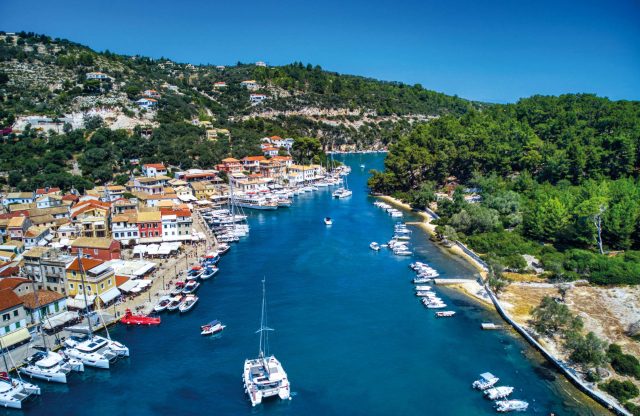
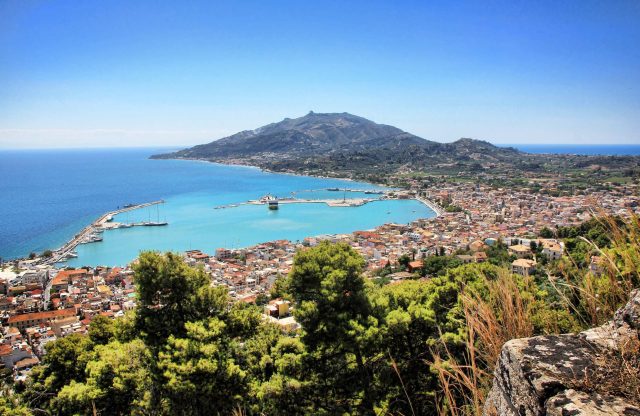
Vathy is the main town and one of the deepest natural harbours in the Mediterranean — the bay curls round so far that boats tie up almost in the middle of the town. The houses were rebuilt after 1953 in the old style, in tiers around the water.
Kioni, in the northeast, is the village people photograph: a small bay with three ruined windmills on the headland above it and pastel houses around the harbour.
Frikes, next to it, is smaller and busier with boats. Stavros is the inland village of the north, with the archaeological collection.
Anogi, at 500 metres, is the highest and the oldest-looking, and the fields around it are scattered with standing stones that the islanders call menhirs.
Perachori, above Vathy, has the remains of the medieval settlement of Palaiochora nearby.


Beaches
Ithaca's beaches are white pebble almost everywhere — sand is genuinely rare here — and the water over that stone is exceptionally clear.
Gidaki is the famous one, and the most photographed image of the island. It is reached by caique from Vathy in about half an hour, or on foot from Skinos in twenty to thirty minutes over rough ground.
Filiatro, fifteen minutes by road from Vathy, is the busiest and fully organised. Sarakiniko, beside it, is two small bays joined by a short path, with less around them.
Dexa, at the head of the bay below Vathy, is the closest of all and the one associated with Odysseus coming ashore.
In the north, Polis lies below Stavros, and Afales is a long remote bay under cliffs. Aspros Gialos is the exception that proves the rule: actual sand.


Food & Drink
Ithaca eats the food of the Ionian, which is the most Italian-influenced cooking in Greece.
Sofrito is veal in a white sauce of garlic, parsley and vinegar. Bourdeto is fish cooked with onion and a great deal of hot red pepper. Both are Corfiot in origin and are made across the islands.
What belongs to Ithaca specifically is kreatopita, a meat pie of the mountain villages, and rovani, a sweet of rice, honey and orange.
The island produces good olive oil, thyme honey and a small amount of wine on the terraces above Perachori.
Where to Stay
Prices shown per night for a sample 3-night stay. Rates and availability vary by season — select your dates for live pricing.
Practical information
Getting around
A car is necessary. The roads are good but constantly winding because of the terrain, and distances that look short take time. Vathy to Kioni is about twenty-five kilometres and around forty minutes.
Boats leave Vathy for Gidaki and the other beaches with no road.
When to go
May, June and September are the best months, and spring and autumn are when the walking works — summer is too hot for the longer routes and there is almost no shade on them.
July and August bring visitors and yachts, but Ithaca never fills the way its neighbours do.
Good to know
The paths are stone, steep and unshaded. Take water and proper shoes, and avoid the middle of the day.
Sand is rare. If you want soft sand, this is not the island for it — the pebble beaches are the point.
Check the current state of access at the School of Homer before going. Work has been done to make it visitable, but arrangements have changed more than once.
Book accommodation ahead for August. There is not much of it.