Kalymnos Island
- Climbing, Hiking-Trekking, Sandy Beaches, Scuba Diving, Yacht Marinas
- Geo Area: Dodecanese

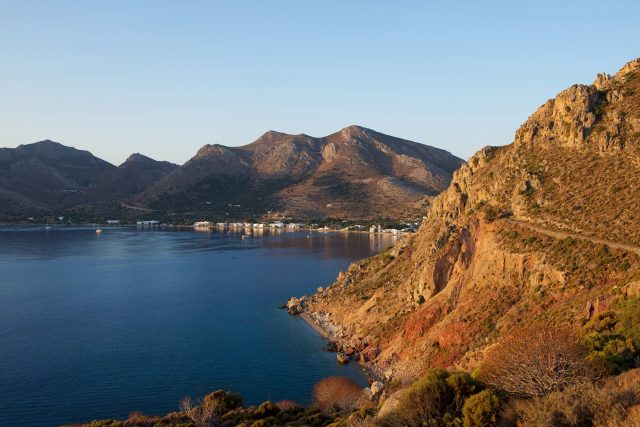
Kalymnos is a mountainous island in the Dodecanese, wedged between Kos and Leros, whose modern identity was built underwater long before it was built on rock. For much of the 19th and 20th centuries this was Greece's sponge-diving island, its fleets working the length of the Mediterranean; today it draws climbers from around the world to limestone cliffs that drop straight into the sea. Its port town, Pothia, still carries the neoclassical stamp of that seafaring wealth, while villages further west face the small islet of Telendos across a narrow strait. A short flight or a longer ferry ride connects the island to Athens and the rest of the Dodecanese.
Activities
Kalymnos has been one of Europe's leading sport-climbing destinations since 1997, when Italian climber Andrea di Bari bolted the island's first 43 routes across the Arhi, Odyssey and Poets sectors. Magazine coverage and a run of climbing festivals through the 2000s spread its reputation, and by 2009 Adam Ondra had climbed Greece's first 9a route here, Los Revolucionarios. The 2023 guidebook counted more than 4,300 routes across dozens of sectors, from the stalactite-hung Grande Grotta to gentler walls above Masouri, with new lines still being bolted most years. Spring and autumn are the best months, when climbers work shaded cliffs in the morning and swim in the afternoon.
Old kalderimia, the stone paths that once linked the villages and monasteries, also make for good walking, from an easy route into Kantouni Bay to the climb up Prophitis Ilias, the island's highest peak at 676 metres; a marked long-distance route, the Kalymnos Trail, crosses the island for experienced trekkers. Along the coast, a dive centre works out of the cove at Gefyra, and deeper water off Therma draws more advanced divers.


History & Culture
Kalymnos was a sponge-diving island long before it was a climbing one, a trade the island traces back to antiquity and that Homer, Aristotle and Plato all mention. Divers originally worked with only a weighted stone, the skandalopetra, to reach the seabed; after 1865 the skafandro diving suit let crews go far deeper and stay down far longer, and Kalymnos built a fleet of some 300 boats that worked sponge grounds across the Mediterranean. The cost was severe: between 1886 and 1910, decompression sickness is estimated to have killed around 10,000 divers and permanently disabled another 20,000, a trauma still commemorated in the island's own Sponge Diver's Dance, choreographed in the 1950s and performed at local festivals to this day.
The industry collapsed almost overnight in the 1980s, when disease wiped out much of the sponge population across the eastern Mediterranean, and the fleet shrank from around 30 boats to four. Sponges are still sold from workshops in Pothia, and the town's Maritime Museum keeps the fuller history, alongside neoclassical buildings left from the Italian administration of 1912-1947.
Villages & Inland
Pothia, the capital and main port, is where most of that seafaring history is visible, in neoclassical facades and in the Church of the Transfiguration, whose marble iconostasis was carved by sculptor Giannoulis Halepas. Chorio, three kilometres inland, was the island's fortified capital before Pothia grew up around the port, and its hilltop Castle of Chora and Pera Kastro were built to keep villagers safe from pirate raids.
The west coast around Myrties and Masouri has become the island's tourism and climbing base, facing the small islet of Telendos across an 800-metre strait; boats cross regularly, since Telendos itself has no cars and only around 60 residents, having been cut off from Kalymnos by an earthquake in the 6th century AD. Vathys, in the north-east, sits in the island's most fertile valley, its fjord-like inlet at Rina used mostly by small boats.


Beaches
Kalymnos isn't primarily a beach island, but a handful are worth planning around. Vlychadia, about 6 kilometres from Pothia, has fine sand and clear water good for snorkeling, while Akti, a little further out, is known for its turquoise-to-emerald colour and gently sloping seabed. Closer to town, the small cove at Gefyra is pebbly rather than sandy, but an easy walk from the centre, with a taverna and a dive centre right on the water.
On the west coast, Melitsahas and Kantouni both have genuine sand, backed by low cliffs or shady trees, and stay relatively quiet even in summer, while Masouri, the busiest of the group, is fully organised with sunbeds and water sports and gets crowded in July and August. None of these are large beaches by island standards, so arriving early in high season still pays off.

Where to Stay
Prices shown per night for a sample 3-night stay. Rates and availability vary by season — select your dates for live pricing.
Practical information
Getting there
Kalymnos National Airport, about 5 kilometres from Pothia, has domestic flights to and from Athens, a journey of roughly an hour, with occasional seasonal hops from Kos and Leros. Ferries run from Piraeus around five times a week in high season, taking 8.5 to 11 hours depending on the route, and connect more frequently to Kos, from where a short crossing from Mastihari port is often the quicker way in, as well as to Rhodes and other Dodecanese islands such as Patmos.
Getting around
A single road connects Pothia to Chorio, Myrties, Masouri, Vathys and Emporios, and buses, taxis and rental cars all cover it, though a hired car or scooter gives the most freedom to explore the smaller villages. There's no bridge to Telendos: small boats leave regularly from Myrties for the short crossing, usually around ten minutes. Pothia itself is compact enough to explore on foot, with the port, museums and main square all close together.
When to go
Spring (April-May) and autumn (September-October) are the busiest and most pleasant months for climbing, with mild temperatures and quieter cliffs than midsummer; accommodation in Myrties and Masouri should be booked well ahead for these periods. Summer brings the best swimming weather but also real heat, and many climbers shift to shaded, west-facing crags for the afternoon. Winters are mild enough for climbing in a t-shirt on good days, though many businesses outside Pothia close for the season.
Good to know
Kalymnos sees far fewer package tourists than neighbouring Kos, and outside Myrties and Masouri's climbing scene, English is less universally spoken in the smaller villages. Visitors to the Monastery of Agios Savvas, on the hill above Pothia, should expect a dress code; appropriate coverings are provided at the entrance. Sturdy shoes are worth packing even for non-climbers, since several of the island's best viewpoints and village lanes are stepped or uneven underfoot.