Kasos Island
- Caves, Hiking-Trekking, Local Products, Traditional Villages
- Geo Area: Dodecanese

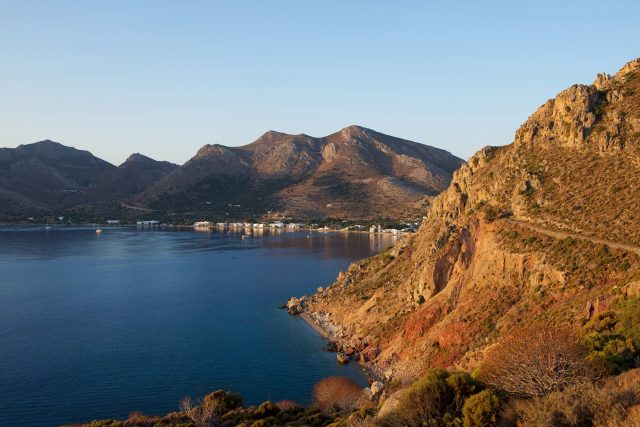
Kasos is a small island in the Dodecanese, south-west of Karpathos and east of Crete. A little over a thousand people live in its five villages, including Fri, the main village and port. Most of the island is rocky hills, crossed by old footpaths between fields, chapels and the sea. Visitors come to walk on a network of marked trails, to swim in quiet coves, and to take a boat to the sandy beach of Armathia, an uninhabited islet off the coast. The island stays quiet in summer, even when many Kasiots who live elsewhere come back for their holidays and for the village festivals. Local food includes sitaka, a soft cheese made on the island, which is mixed with hand-made pasta.
Nature & Outdoors
More than ten numbered walking routes cross Kasos. Most follow old paths that shepherds and farmers used between the villages, the fields and the sea, past olive groves, stone shepherd huts called mitata, chapels and monasteries. The shortest is a path of under 2 km down to a beach, and the longest take about four hours. One route climbs to the top of Mount Prionas, at 550 metres the highest point of the island. There is very little shade, so carry plenty of water.
Two caves lie close to the village of Agia Marina. Stylokamara, also called Selai, can be reached only on foot, about 2 km from the village. It is some 30 metres deep, with stalactites. From the area around it there is a wide view over the west coast and the islet of Armathia. At Ellinokamara, a wall of huge unworked stones, built in ancient times, closes the mouth of a cave that was used for worship. The archaeological service looks after the site, so check locally whether you can go inside.
Beaches
The easiest beaches to reach are close to Fri, the main village and port of the island. Emporios, a short walk from the port, is the beach most people use, with sand, clear water, sunbeds and tavernas. Kofteri, right beside the port, is also sandy. On the west side, Ammoua has a small chapel of Agios Konstantinos on its shore, with a view of the sunset. Antiperatos is a group of four quiet coves with coloured pebbles, reached by a paved road.
In the south, Helatros is a pebble beach in a natural harbour sheltered from the wind. Avlaki is a small cove with turquoise water, reached by boat or by a footpath of under 2 km from the monastery of Agios Georgios at Chadies. On the islet of Armathia, Marmara has fine white sand and very clear water. It can be reached only by sea. Boats take visitors there from Fri, so check locally when they run.
Villages & Inland
Fri, the main village and port, was built around the small natural harbour of Bouka. Its lanes are paved with pebble mosaics and lined with the stone houses of former sea captains, small white houses and many churches. A ten-minute walk away, Panagia is known for the Six Churches, a group of chapels joined together as one building.
A little over a thousand people live on Kasos, in five villages. Agia Marina, the largest, is built on a hilltop. The courtyard of its church has a black-and-white pebble mosaic. Poli is thought to be the oldest settlement and stands on the site of an ancient acropolis. Arvanitochori lies about 2 km beyond Panagia, at around 100 metres above the sea. The villages are fullest in summer, when many Kasiots who live elsewhere come back for the season.
History & Culture
The Archaeological Collection of Kasos, in a traditional building in Fri, the main village, shows finds from prehistoric to early Christian times. It also has displays on the island's part in the War of Independence of 1821 and on the destruction of 1824.
In June 1824, a fleet sent by Mehmet Ali of Egypt attacked Kasos because the island had taken part in the war. About 500 people were killed and around 2,000 were taken as slaves. A memorial in Fri recalls the dead, and every June the island marks the anniversary with several days of memorial services, traditional dances and a running race.
Kasos had a long tradition of shipbuilding and sea trade. From the second half of the 19th century, many Kasiots emigrated, first to Egypt, where about 5,000 settled, and later to Istanbul, the United States and South Africa.
Food & Drink
Sitaka is a soft cheese with a strong taste, made on Kasos and Karpathos. In the past, shepherds salted fermented sheep's or goat's milk and stirred it over a wood fire for seven or eight hours. A dairy in the village of Agia Marina makes it by machine from local sheep's milk. Its main use is in makarounes, hand-made pasta mixed with sitaka and onions fried in butter until golden.
Other local dishes include doulmades, small stuffed vine leaves; roikio, wild samphire eaten as a salad or cooked with tomato; and sweets such as moshopoungia, small pastries of almond and sugar. Local food is also served at the summer festivals, with music and dancing: the feast of Agia Marina on 17 July and the feast in the village of Panagia on 15 August.
Where to Stay
Prices shown per night for a sample 3-night stay. Rates and availability vary by season — select your dates for live pricing.
Practical information
Getting there
Ferries arrive at Fri, the main port of Kasos, all year from Piraeus, a trip of about 12 hours, and from Karpathos, Rhodes, and Sitia and Heraklion in Crete. Some sailings also call at Santorini and Anafi. The shortest crossing is from Karpathos, about an hour. Small planes link the airport near Fri with Karpathos and with Sitia. Check current schedules for boats and flights, as sailings are fewer in winter.
Getting around
Roads connect Fri, the main village and port, with the other villages and with most beaches. Cars, motorbikes and bicycles can be rented on the island. The village of Panagia is a ten-minute walk from Fri. Remote beaches and the islet of Armathia are reached by boat from Fri. Some places, such as the cave of Stylokamara and the beach at Avlaki, can be reached only on foot or by sea.
When to go
Many people from Kasos who live elsewhere come back in July and August. Three dates bring many people to the island: the memorial days for 1824 in June, the feast of Agia Marina on 17 July in the village of the same name, and the feast in the village of Panagia on 15 August. Book early if you plan to visit on these dates.
Good to know
The Archaeological Collection in Fri, the main village, is usually open from April to October and closed on Tuesdays, so check current hours. There is very little shade on the trails, so carry plenty of water and sun protection. On windy days, the beaches on the north side of the island are more exposed to the wind. Helatros, in the south, lies in a natural harbour sheltered from the wind.