Platamonas
- Landmark Castles, Sandy Beaches
- Geo Area: Macedonia

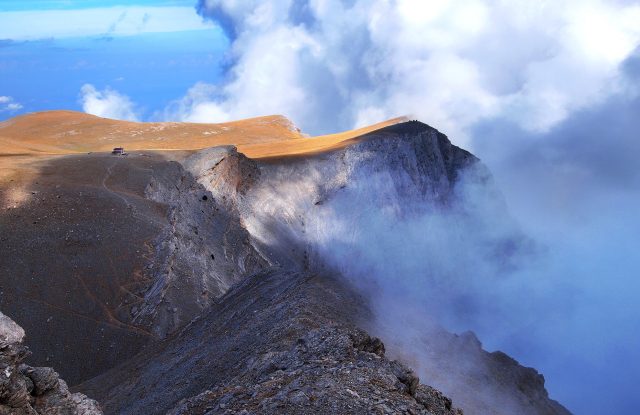
Platamonas is a coastal town in Pieria, in Macedonia, at the southern end of the Thermaic Gulf. Mount Olympus rises directly behind it, and the sea is a few hundred metres in front.
Above the town stands the Castle of Platamon, the best preserved castle in northern and central Greece. It sits on a rocky hill over the narrow strip where the motorway, the railway and the coast all squeeze past each other. This was always the point of it: whoever held this hill controlled the road between Macedonia and Thessaly.
The town below is a modern beach resort, built along a long sandy coast, and it fills up with Greek families in July and August.
History & Culture
The name Platamon means a rocky headland by the sea, and the hill has been fortified for a very long time.
An ancient city called Herakleion stood here. A Greek sailing guide of the fourth century BC calls it the first city of Macedonia — the first place you reached after coming north through the Tempe pass. Excavations have found pottery that suggests Greeks were living here perhaps as early as the eighth century BC.
A Byzantine fortified town probably stood on the hill from the tenth century. The name Platamonas first appears in a Byzantine imperial document of 1198.
The castle you see today
After the Fourth Crusade of 1204, Pieria was given to Boniface of Montferrat as part of the Frankish Kingdom of Thessalonica. A Lombard knight named Rolando Piscia built the castle between 1204 and 1222.
The Franks did not keep it long. Theodore Komnenos Doukas took it back when he destroyed their kingdom.
Through the thirteenth and fourteenth centuries the castle was used as a refuge, and also as a prison for important men who had fallen out with the Byzantine emperor. Its defences were strengthened with an octagonal keep, which stands inside the acropolis behind a wall of its own. That keep is what you see from the motorway.
The Ottomans took Platamonas some time after 1386.
Concerts in the castle
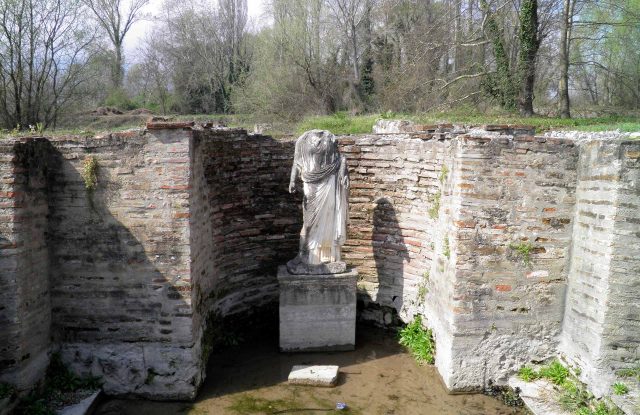
Every summer the castle is one of the main venues of the Olympus Festival, which has run for more than fifty years. Between early July and early September it hosts concerts and theatre inside the walls, alongside performances at the ancient theatre of Dion and other sites in Pieria.


Villages & Inland
Behind the coast, the slopes of Lower Olympus hold a set of old villages that people abandoned when they moved down to the sea. Several have since been restored.
Palaios Panteleimonas is the best known, seven kilometres from Platamonas and about 470 metres up, on a slope covered in chestnut and oak. It has stone houses in the Macedonian style, a square with cafés under plane trees, a municipal art gallery, and a view over the whole coast of Pieria. Most people in Platamonas are descended from families who lived there.
Palaia Skotina and Palaioi Poroi are the other two, higher and much quieter.
The three are connected by footpaths through chestnut, pine and plane woods, with the castle and the sea below you for most of the way. Walking from Palaia Skotina to Palaios Panteleimonas takes about two and a half hours.


Beaches
The coast here is one long strip of sand and fine shingle, running for kilometres in both directions, with Olympus behind it and the Aegean in front.
Platamonas beach is the town's own: sandy, organised, with sunbeds, umbrellas and beach bars, and shallow water.
Nei Poroi, three kilometres south, has a longer stretch of sand and shallow water, and is the usual family choice.
Skotina, about seven kilometres north, is quieter, and the section below the castle is where most of the campsites are.
Leptokarya, ten kilometres north, mixes sand and pebbles and is calmer again.
The whole coast is sheltered, and the water is usually flat. It is warm, shallow and easy rather than dramatic.

Where to Stay
Prices shown per night for a sample 3-night stay. Rates and availability vary by season — select your dates for live pricing.
Practical information
Getting there
Platamonas is on the main Athens–Thessaloniki motorway, with its own exit, and on the main railway line — trains from both Athens and Thessaloniki stop at the station in the town. Thessaloniki is about an hour and a half by car, Larissa about an hour. Thessaloniki airport is the nearest, roughly 100 km north.
Getting around
The town runs along the coast road and you can walk most of it. A car helps a great deal for anything else: the old villages up the mountain, the neighbouring beaches, and Dion or Litochoro. Buses connect the coastal towns of Pieria with Katerini, but they are not frequent. The road up to Palaios Panteleimonas is narrow and winding, but paved and short.
When to go
June to September for the beaches, with July and August the busiest. July and August are also when the Olympus Festival takes place, and a concert in the castle is the reason to be here in the evening rather than only in the afternoon. Spring and autumn are better for the castle itself and for walking between the old villages, when it is cooler and there is no queue.
Good to know
The castle is a steep climb from the town, and there is a road up to a car park below the gate. It has almost no shade, so go early or late in summer, and wear shoes with grip — the ground is uneven stone. Check current opening hours before you go up, and note that on festival evenings the site may close early to the public. The weather on this coast can turn quickly because of Olympus; a summer thunderstorm is not unusual.
Platamonas— been there?Tell others what you saw.
A photo and two lines are enough.