Attica Administrative Region Invites You to Uncover Its Iconic Destinations!

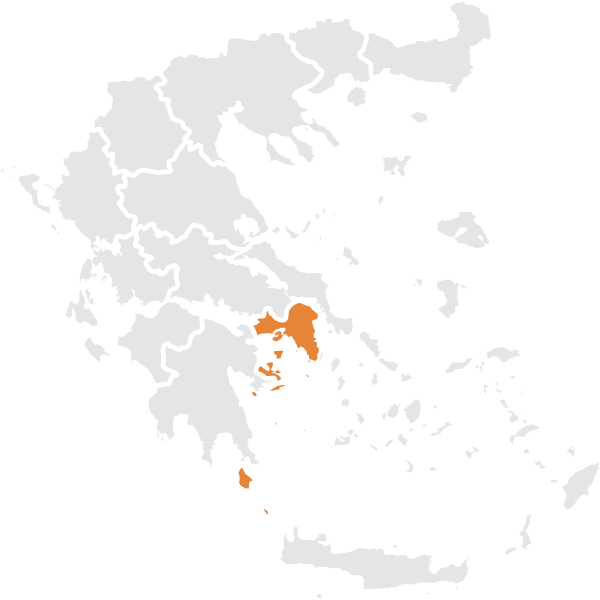
Attica Admin

Located in the heart of Greece, Attica blends ancient history with modern energy. Home to Athens and the iconic Acropolis, the region offers a rich mix of cultural landmarks, scenic coastlines, and vibrant urban life. Whether exploring historic sites, relaxing on the Athenian Riviera, or enjoying world-class cuisine, Attica promises a unique and unforgettable Greek experience.

Cultural Heritage, Local Experiences, Day Trips & Natural Wonders

Attica, the historical heart of Greece, offers an extraordinary journey through time and tradition. From ancient ruins to vibrant local festivals, the region provides a wealth of cultural experiences that resonate with the stories of ancient civilization, Byzantine influence, and modern Greek culture. Visitors can immerse themselves in the unique character of Attica by exploring its museums, historic landmarks, and traditional neighborhoods.

Visitors can immerse themselves in authentic local experiences, from savoring delicious traditional dishes like moussaka and souvlaki to participating in vibrant local festivals. The Ioannina Carnival and the Zagori Festival celebrate the region’s rich cultural heritage through music, dance, and local cuisine, attracting both residents and tourists alike.

Beyond its rich cultural offerings, Attica is also home to stunning natural landscapes that captivate outdoor enthusiasts and nature lovers alike. The region’s beautiful coastline, lush mountains, and serene parks offer plenty of opportunities for hiking, swimming, and relaxation. Whether you’re exploring the Athenian Riviera or hiking through the hills of Parnitha, Attica’s natural wonders are not to be missed.

Attica Regional Projects

The Attica region is dedicated to enhancing its cultural and natural heritage while fostering sustainable development for locals and tourists alike. Here are some of the key initiatives shaping the future of the region:

Cultural Heritage Restoration: Major efforts are underway to preserve and restore Attica’s historical monuments, including the ongoing conservation of the Acropolis and the revitalization of lesser-known archaeological sites.

Infrastructure Development: Attica continues to improve its transportation networks, including upgrades to metro and tram lines, making it easier for visitors to explore the region’s diverse attractions.

Sustainable Tourism Initiatives: The region is committed to promoting eco-friendly tourism practices, such as responsible waste management and the protection of natural habitats, ensuring a sustainable future for Attica’s natural beauty.

Community Engagement: Local communities are actively involved in preserving and sharing their heritage. Visitors can participate in local festivals, traditional crafts workshops, and culinary experiences that reflect the soul of Attica.

Why Visit Attica?

Attica is more than just the gateway to Athens – it’s a region that bridges the past and the present, blending vibrant city life with tranquil coastal retreats. The region offers something for everyone, from ancient monuments and cultural gems to picturesque beaches and mountainous trails. Whether you are drawn to its history, local cuisine, or natural beauty, Attica promises a rich and rewarding experience. Plus, its close proximity to world-renowned islands and easy accessibility make it a perfect starting point for broader Greek adventures.

Top Exciting Travel Routes in Attica

Travel Route
Athens. Street in Plaka.

A Relaxed Journey through the Charms of Attica

For casual travelers, Attica offers an enjoyable mix of leisurely sightseeing and laid-back experiences. Begin in Athens, wandering through Plaka and Monastiraki for a taste of traditional shops and picturesque streets. Head to the Acropolis Museum for a casual exploration of ancient artifacts, followed by a stroll up Philopappos Hill to enjoy the views and unwind. Nearby, the Anafiotika Neighborhood offers a quiet escape, with Cycladic-style houses nestled under the Acropolis, giving a serene, village feel right in the heart of Athens.

For a cultural stop, head to the Stavros Niarchos Foundation Cultural Center (SNFCC). Its expansive park is perfect for a leisurely walk, with chances to catch open-air concerts or film screenings in its vibrant green spaces. In Piraeus, Zea and Mikrolimano Marinas, offers a relaxed seaside experience ideal for a waterfront meal or sunset stroll.

For beach lovers, the Athenian Riviera is perfect, with options like Glyfada, Voula, and Vouliagmeni providing sandy shores and relaxing seaside cafes. You can also explore Vouliagmeni Lake for a swim in its thermal waters, a wonderful escape from the city. For a scenic coastal drive, head down to Cape Sounion and catch a beautiful sunset at the Temple of Poseidon. The Glyfada Golf Club, located in the Athenian Riviera, is a 18-hole course close to the beach and city center, offering a convenient golfing option near Athens.

Day trips to nearby destinations, such as Hydra and Aegina, are a great addition, offering a relaxed island vibe without venturing far from Athens. These islands provide a perfect blend of casual sightseeing, beaches, and local tavernas, making them ideal for a laid-back experience in Greece.

For casual travelers, Attica offers an enjoyable mix of leisurely sightseeing and laid-back experiences. Begin in Athens, wandering through Plaka and Monastiraki for a taste of traditional shops and picturesque streets. Head to the Acropolis Museum for a casual exploration of ancient artifacts, followed by a stroll up Philopappos Hill to enjoy the views and unwind. Nearby, the Anafiotika Neighborhood offers a quiet escape, with Cycladic-style houses nestled under the Acropolis, giving a serene, village feel right in the heart of Athens.

For a cultural stop, head to the Stavros Niarchos Foundation Cultural Center (SNFCC). Its expansive park is perfect for a leisurely walk, with chances to catch open-air concerts or film screenings in its vibrant green spaces. In Piraeus, Zea and Mikrolimano Marinas, offers a relaxed seaside experience ideal for a waterfront meal or sunset stroll.

For beach lovers, the Athenian Riviera is perfect, with options like Glyfada, Voula, and Vouliagmeni providing sandy shores and relaxing seaside cafes. You can also explore Vouliagmeni Lake for a swim in its thermal waters, a wonderful escape from the city. For a scenic coastal drive, head down to Cape Sounion and catch a beautiful sunset at the Temple of Poseidon. The Glyfada Golf Club, located in the Athenian Riviera, is a 18-hole course close to the beach and city center, offering a convenient golfing option near Athens.

Day trips to nearby destinations, such as Hydra and Aegina, are a great addition, offering a relaxed island vibe without venturing far from Athens. These islands provide a perfect blend of casual sightseeing, beaches, and local tavernas, making them ideal for a laid-back experience in Greece.

Read more

Route Highlights

(in Places & Attractions)

The Acropolis Museum is the only museum in the world dedicated entirely to one archaeological site. Everything in it — more than four thousand objects — was found on the Acropolis rock or on the slopes below it, and almost all of it is shown within sight of where it once stood. The museum is in the centre of Athens.

The building opened in 2009. It was designed by Bernard Tschumi with the Greek architect Michael Photiadis, and it was meant to be ready for the 2004 Olympics. But when they dug the foundations, they found a whole Athenian neighbourhood from the fifth century AD underneath. The design was changed so that the museum stands on pillars above it. The excavation is still there: you walk over it on glass floors, and you can also visit it below the museum.

How the building works

The three main levels match the three zones of the Acropolis.

The ground floor holds finds from the slopes, in a long hall with a sloping floor that imitates the climb up the rock.

Above it, the Archaic Gallery is an open space full of sixth-century statues, lit from every side. You are meant to walk around them rather than past them. The Erechtheion room holds five of the six original Caryatids.

The Parthenon Gallery

The top floor is the point of the whole building.

It is turned twenty-three degrees away from the rest of the structure, so that it sits at exactly the same orientation as the temple. It has the same dimensions as the temple. It is enclosed in glass, so the sculptures are lit by the same daylight — and the Parthenon itself is visible through the windows. The frieze runs in one continuous line around a rectangular core, at eye level.

The gallery is also visibly incomplete. About half of the surviving Parthenon sculptures are in the British Museum in London. Their places here are filled with plaster copies, left deliberately pale so that they stand out against the original marble. The sixth Caryatid is in London too.

Talks between Athens and the British Museum have gone on for years without a result. The gaps in the gallery are part of how the museum makes its argument.

(in Places & Attractions)

Aegina is the closest island to Athens, forty minutes by hydrofoil from Piraeus, and it is part of the Saronic Islands. For its size, it holds a remarkable amount of history.

It was the first city-state in Europe to make its own coins — silver staters stamped with a sea turtle. Two and a half thousand years later, it became the first capital of the modern Greek state.

The inland part of the island is planted with pistachio orchards. This crop has shaped the local economy since the last century and now has protected origin status. Among the orchards you will find an Archaic temple, an abandoned medieval town full of stone chapels, and one of the most visited pilgrimage sites in Greece.

(in Places & Attractions)

Cape Sounion is the southern tip of Attica, where the mainland ends. The Temple of Poseidon stands on the edge of a cliff about sixty metres above the sea, and from it you can see the Saronic islands and, on a clear day, a long way across the Aegean.

Ships coming up from the south saw this temple first. That was the point of putting it here.

The sanctuary

People were worshipping on this rock long before the temple was built. There is evidence of sanctuaries from around the eleventh century BC, and finds from the wider area go back much further.

Four marble kouroi — large standing statues of young men — were made around 590–580 BC and set up here. They were smashed, most probably by the Persians in 480 BC, and buried in the sanctuary. Two of them are now in the National Archaeological Museum in Athens, together with the architectural pieces from the site.

The Persians destroyed an earlier temple of Poseidon at the same time.

The temple

What stands today was built between about 444 and 440 BC, in the same period as the Parthenon. It is Doric, made of local marble, and it sits on a platform 31 by 13.5 metres at the highest point of the cape.

Sixteen of its columns are still upright, together with two pillars of the porch. On the right-hand one, as you walk in, is the carved signature of Lord Byron, who came here in 1810. He was following a habit that visitors had been practising since Roman times, and the surrounding stone carries many other names.

The second temple and the fortress

Lower down, on a separate terrace, stood the Temple of Athena Sounias. Its plan was unusual enough that the Roman architect Vitruvius wrote about it: instead of columns on all four sides, it had them on two only, the south and the east.

For centuries the two temples were confused. Pausanias, writing in the second century AD, described the temple on the cliff as Athena's. The mistake was only corrected in the early twentieth century, by excavation.

Sounion was also a fortress. In 412 BC, during the Peloponnesian War, the Athenians walled the whole headland to protect the grain ships that had to round this cape to reach Athens. Parts of those walls and towers survive, and they were repaired again in the third century BC.

King Aegeus

The cape carries one of the best-known Athenian legends. Theseus sailed to Crete to kill the Minotaur and promised his father Aegeus that he would raise white sails on the return if he survived. He forgot. Aegeus, watching from the cliff, saw black sails, believed his son was dead, and threw himself into the sea — which has been called the Aegean ever since.

(in Places & Attractions)

Hydra is a rocky island in the Saronic Islands, about two hours from Piraeus, with one town built in a steep amphitheatre around its harbour.

There are no cars on it. A presidential decree of the 1950s banned motor vehicles to protect the town, and the ban has held ever since — the only exceptions are the fire engine, the ambulance and the refuse lorry. Everything else moves on foot, by donkey and mule, or by water taxi.

The stone mansions around the harbour were built by shipowners. In 1821 the island sent 120 ships and around 5,400 sailors to the Greek revolution, and the admirals who commanded the Greek fleet came from these houses.

Since the 1950s it has also been a place artists come to, and some of them stayed.

(in Places & Attractions)

Nestled just southwest of the Acropolis, Philopappos Hill is one of the most historically rich and scenic spots in Athens, offering stunning panoramic views of the city. Often referred to as the "Hill of the Muses" in antiquity, this landmark combines natural beauty with historical significance, making it a must-visit for anyone exploring Athens.

A Walk Through History
Philopappos Hill is named after Gaius Julius Antiochus Epiphanes Philopappos, a prominent Roman official of Greek descent. He was known for his deep ties to both Rome and Athens, and upon his death in 116 AD, the people of Athens erected a grand monument in his honor. This marble tomb, still standing at the hill's summit, is a remarkable piece of Roman funerary architecture that highlights the esteem in which Philopappos was held.

But Philopappos Hill’s historical relevance goes back much further than Roman times. In ancient Greece, the hill was associated with Mousaios, a mythical poet said to be a disciple of Orpheus. The hill was part of the city’s defensive system, with remnants of Themistoclean walls from the 5th century BC still visible today.

Natural Beauty and Stunning Views
While the historical significance of Philopappos Hill is undeniable, its natural allure makes it equally compelling. The winding paths lined with pine trees and native flora lead visitors up to the monument, and along the way, you'll encounter numerous scenic viewpoints. The hill provides breathtaking vistas of the Acropolis, the Aegean Sea, and the sprawling cityscape of Athens.

During a hike up Philopappos, you can take in views of nearby landmarks such as Pnyx Hill, the birthplace of democracy where ancient Athenians gathered for assemblies, and Hill of the Nymphs.

(in Places & Attractions)

Plaka and Monastiraki are two old quarters in the centre of Athens, in Attica. They lie side by side at the northern foot of the Acropolis, and it is easy to walk through both on the same day. Plaka has low houses, narrow streets and the small white houses of Anafiotika under the rock. Monastiraki has a square with a metro station, a church and a mosque of 1759, and a flea market starts a few steps away. In and around the two quarters are three ancient sites: the Ancient Agora, the Roman Agora with the Tower of the Winds, and Hadrian's Library. Tavernas, cafés and shops fill the streets of both quarters.

Travel Route
Five marble female statues standing on a low platform in a bright gallery with grey walls

Walk Through Time: Exploring Attica’s Timeless Heritage

Attica invites cultural explorers to delve deep into Greece’s rich history and ancient landmarks. Begin in Athens at the Acropolis, with its majestic Parthenon, a masterpiece of classical Greek architecture. Just below, the Acropolis Museum displays sculptures and relics from the Acropolis itself, offering a closer look at ancient Greek artistry.

For a broader museum experience, visit the National Archaeological Museum, where treasures like the Mask of Agamemnon and an expansive collection from Greek antiquity await. The Byzantine and Christian Museum provides a glimpse into medieval Greece through stunning icons, mosaics, and religious artifacts, while the Benaki Museum offers a comprehensive journey through Greek history, from antiquity to modern times.

Stroll through the historic neighborhoods of Plaka and Monastiraki, where traditional shops, charming cafes, and narrow streets reveal the heart of Athens’ old and new worlds. Nearby, the Temple of Hephaestus in the Ancient Agora is a beautifully preserved, lesser-known gem ideal for a quieter exploration. If your timing allows, catch a performance at the Herodion Theatre (Odeon of Herodes Atticus), an ancient theater nestled at the foot of the Acropolis.

Beyond Athens, head to Cape Sounion to see the Temple of Poseidon, where breathtaking coastal views enhance the site’s architectural beauty, especially at sunset. The Kerameikos Cemetery and Museum provides an insightful journey into ancient Greek burial practices, and the surrounding area adds another layer to the historical experience.

For those eager to explore Greece’s broader heritage, Delphi makes a rewarding day trip. Once the center of the ancient Greek world, Delphi’s Oracle and Temple of Apollo offer a glimpse into the spiritual heart of Greece. Mycenae, with its Cyclopean walls and royal tombs, is another day trip option, providing insight into the Mycenaean civilization that inspired Homer’s epic tales.

Attica invites cultural explorers to delve deep into Greece’s rich history and ancient landmarks. Begin in Athens at the Acropolis, with its majestic Parthenon, a masterpiece of classical Greek architecture. Just below, the Acropolis Museum displays sculptures and relics from the Acropolis itself, offering a closer look at ancient Greek artistry.

For a broader museum experience, visit the National Archaeological Museum, where treasures like the Mask of Agamemnon and an expansive collection from Greek antiquity await. The Byzantine and Christian Museum provides a glimpse into medieval Greece through stunning icons, mosaics, and religious artifacts, while the Benaki Museum offers a comprehensive journey through Greek history, from antiquity to modern times.

Stroll through the historic neighborhoods of Plaka and Monastiraki, where traditional shops, charming cafes, and narrow streets reveal the heart of Athens’ old and new worlds. Nearby, the Temple of Hephaestus in the Ancient Agora is a beautifully preserved, lesser-known gem ideal for a quieter exploration. If your timing allows, catch a performance at the Herodion Theatre (Odeon of Herodes Atticus), an ancient theater nestled at the foot of the Acropolis.

Beyond Athens, head to Cape Sounion to see the Temple of Poseidon, where breathtaking coastal views enhance the site’s architectural beauty, especially at sunset. The Kerameikos Cemetery and Museum provides an insightful journey into ancient Greek burial practices, and the surrounding area adds another layer to the historical experience.

For those eager to explore Greece’s broader heritage, Delphi makes a rewarding day trip. Once the center of the ancient Greek world, Delphi’s Oracle and Temple of Apollo offer a glimpse into the spiritual heart of Greece. Mycenae, with its Cyclopean walls and royal tombs, is another day trip option, providing insight into the Mycenaean civilization that inspired Homer’s epic tales.

Read more

Route Highlights

(in Places & Attractions)

The Acropolis Museum is the only museum in the world dedicated entirely to one archaeological site. Everything in it — more than four thousand objects — was found on the Acropolis rock or on the slopes below it, and almost all of it is shown within sight of where it once stood. The museum is in the centre of Athens.

The building opened in 2009. It was designed by Bernard Tschumi with the Greek architect Michael Photiadis, and it was meant to be ready for the 2004 Olympics. But when they dug the foundations, they found a whole Athenian neighbourhood from the fifth century AD underneath. The design was changed so that the museum stands on pillars above it. The excavation is still there: you walk over it on glass floors, and you can also visit it below the museum.

How the building works

The three main levels match the three zones of the Acropolis.

The ground floor holds finds from the slopes, in a long hall with a sloping floor that imitates the climb up the rock.

Above it, the Archaic Gallery is an open space full of sixth-century statues, lit from every side. You are meant to walk around them rather than past them. The Erechtheion room holds five of the six original Caryatids.

The Parthenon Gallery

The top floor is the point of the whole building.

It is turned twenty-three degrees away from the rest of the structure, so that it sits at exactly the same orientation as the temple. It has the same dimensions as the temple. It is enclosed in glass, so the sculptures are lit by the same daylight — and the Parthenon itself is visible through the windows. The frieze runs in one continuous line around a rectangular core, at eye level.

The gallery is also visibly incomplete. About half of the surviving Parthenon sculptures are in the British Museum in London. Their places here are filled with plaster copies, left deliberately pale so that they stand out against the original marble. The sixth Caryatid is in London too.

Talks between Athens and the British Museum have gone on for years without a result. The gaps in the gallery are part of how the museum makes its argument.

(in Places & Attractions)

The Acropolis stands above Athens on a limestone rock 157 metres high. The name comes from two Greek words: akron, the high point, and polis, the city. People have lived here since the Bronze Age, and the rock has been a sacred place for almost as long.

Almost everything you see today was built in a single period of about forty years.

The Persians burned the earlier sanctuary in 480 BC. After that, Pericles began a building programme that produced the Parthenon (447–438 BC, with its sculpture finished by 432), the great Propylaea gateway, the small Temple of Athena Nike, and the Erechtheion with its porch of Caryatids. Inside the Parthenon stood an enormous statue of Athena, made of gold and ivory, which has long since disappeared. The building was the city treasury as much as a temple.

What happened after antiquity

The Parthenon became a Christian church around the sixth century, and then a mosque after the Ottoman conquest of 1458. Through all of this it stayed almost complete, with its roof and sculpture still in place.

On 26 September 1687, during a Venetian siege, a mortar shell hit the gunpowder that the Ottoman garrison had stored inside. The explosion destroyed the centre of the building. The open shell you see today — columns standing, roof gone — is the result of that single evening.

A little over a century later, agents working for Lord Elgin removed about half of the surviving sculptures and shipped them to London. They are still in the British Museum.

Restoration

Work has continued without a break since 1975. The teams use new Pentelic marble, cut from the original ancient quarries, and they are also undoing the damage caused by earlier, cruder repairs.

The Caryatids on the Erechtheion are copies. The originals are three hundred metres downhill in the Acropolis Museum, together with the frieze, the pediments and the metopes.

(in Places & Attractions)

Cape Sounion is the southern tip of Attica, where the mainland ends. The Temple of Poseidon stands on the edge of a cliff about sixty metres above the sea, and from it you can see the Saronic islands and, on a clear day, a long way across the Aegean.

Ships coming up from the south saw this temple first. That was the point of putting it here.

The sanctuary

People were worshipping on this rock long before the temple was built. There is evidence of sanctuaries from around the eleventh century BC, and finds from the wider area go back much further.

Four marble kouroi — large standing statues of young men — were made around 590–580 BC and set up here. They were smashed, most probably by the Persians in 480 BC, and buried in the sanctuary. Two of them are now in the National Archaeological Museum in Athens, together with the architectural pieces from the site.

The Persians destroyed an earlier temple of Poseidon at the same time.

The temple

What stands today was built between about 444 and 440 BC, in the same period as the Parthenon. It is Doric, made of local marble, and it sits on a platform 31 by 13.5 metres at the highest point of the cape.

Sixteen of its columns are still upright, together with two pillars of the porch. On the right-hand one, as you walk in, is the carved signature of Lord Byron, who came here in 1810. He was following a habit that visitors had been practising since Roman times, and the surrounding stone carries many other names.

The second temple and the fortress

Lower down, on a separate terrace, stood the Temple of Athena Sounias. Its plan was unusual enough that the Roman architect Vitruvius wrote about it: instead of columns on all four sides, it had them on two only, the south and the east.

For centuries the two temples were confused. Pausanias, writing in the second century AD, described the temple on the cliff as Athena's. The mistake was only corrected in the early twentieth century, by excavation.

Sounion was also a fortress. In 412 BC, during the Peloponnesian War, the Athenians walled the whole headland to protect the grain ships that had to round this cape to reach Athens. Parts of those walls and towers survive, and they were repaired again in the third century BC.

King Aegeus

The cape carries one of the best-known Athenian legends. Theseus sailed to Crete to kill the Minotaur and promised his father Aegeus that he would raise white sails on the return if he survived. He forgot. Aegeus, watching from the cliff, saw black sails, believed his son was dead, and threw himself into the sea — which has been called the Aegean ever since.

(in Places & Attractions)

Delphi stands on a steep slope of Mount Parnassus, in Central Greece, looking down a valley of olive trees towards the Gulf of Corinth. For a thousand years it was the most important religious site in the Greek world, and Greeks believed it was the centre of the earth.

The story explains the claim. Zeus released two eagles from opposite ends of the world and let them fly towards each other. They met here. The spot was marked with a stone called the omphalos — the navel.

The oracle

Apollo took the sanctuary by killing Python, the serpent that guarded it. From then on the god spoke here through a priestess, the Pythia.

The process was strict. Before speaking she washed and drank at the Castalian Spring, then went down into the innermost room of the temple, sat on a bronze tripod and chewed laurel leaves. Those who came to ask had to purify themselves at the same spring, offer a cake and an animal, submit their question to the priests in advance, and draw lots for the order in which they would be heard. They stood where they could not see her.

At first the oracle spoke only once a year, on Apollo's birthday. Later it was one day a month, and not in winter, when the god was believed to be elsewhere. That is nine days in a year — and kings, cities and generals across the Mediterranean planned around them. At the busiest periods three women served as Pythia to keep up.

The answers were famously open to more than one reading. The most quoted example is the reply given to Croesus of Lydia, who was told that if he attacked Persia he would destroy a great empire. He attacked. The empire he destroyed was his own.

Wealth and war

Cities that received good answers sent gifts. They built small marble buildings along the road up to the temple, called treasuries, to hold them, and filled the sanctuary with hundreds of bronze and marble statues. Delphi became extraordinarily rich.

That wealth was fought over. Four Sacred Wars were declared over control of the sanctuary between the sixth and fourth centuries BC. The Amphictyonic League, an association of Greek peoples, managed it, and the Pythian Games were held here every four years — the second most important games after Olympia, and the only ones with musical as well as athletic contests.

The last recorded prophecy was given around AD 393, when the emperor Theodosius ordered all pagan sanctuaries closed.

The village on top

By the Middle Ages a village called Kastri stood on the sanctuary, its houses built out of the ancient stone. Everyone knew what lay underneath, but nobody could excavate a living settlement.

It took an earthquake in 1870 and a determined Greek government to change that. The whole village was bought out and moved to where modern Delphi now stands, and in 1892 the French Archaeological School began what became known as the Great Excavation. They laid a small railway across the site to carry away the spoil. Within a year they had uncovered the Treasury of the Athenians.

What to see today

The Sacred Way climbs in a zigzag from the entrance. It is lined with the bases of monuments and the remains of the treasuries, of which the Treasury of the Athenians has been rebuilt and stands complete.

Above it is the Temple of Apollo, with six columns re-erected. The famous maxims — Know thyself, Nothing in excess — were carved at its entrance.

Higher still is the theatre, and above that a steep path leads to the stadium, where the Pythian Games were run. It is the best preserved in Greece and most visitors do not make the climb. It is worth it.

Below the main site, on the other side of the road, is the separate Sanctuary of Athena Pronaia, with the Tholos — a circular building of the fourth century BC, three of whose columns still stand. Nobody knows what it was for. Between the two sites, beside the road, is the Castalian Spring.

The Archaeological Museum is at the entrance. Its best-known object is the Charioteer of Delphi, also called Heniokhos, the rein-holder.

It is a life-size bronze of about 470 BC, and one of only about five large Greek bronzes that survive from the classical period. It was dedicated by Polyzalus, the ruler of Gela in Sicily, after his chariot team won at the Pythian Games, and it originally stood in a group with a chariot, four horses and two grooms. Only the driver came through complete, apart from his left arm.

It survived because it was buried. The earth protected the metal, and the statue still has its inlaid glass eyes.

The museum also holds the Sphinx of the Naxians, the twin archaic statues of Kleobis and Biton, and the omphalos stone.
(in Places & Attractions)

Nestled in the northeastern Peloponnese, the ancient site of Mycenae offers a window into a civilization that flourished over 3,000 years ago. Revered as one of the major centers of Greek civilization, Mycenae's archaeological wonders captivate history enthusiasts.

Historical Significance

Mycenae, the legendary city of King Agamemnon, holds a pivotal place in Greek mythology and Homeric epics. The city dates back to the second millennium BCE and was a dominant cultural and military power. Its influence stretched across the Aegean world, marking the height of the Mycenaean civilization, which is often referred to as the cradle of Greek culture. The Mycenaeans are credited with developing the early Greek language and script known as Linear B, contributing significantly to the foundations of classical Greek culture.

The Lion Gate

One of the most iconic structures at Mycenae is the Lion Gate, the main entrance to the citadel. Built around 1250 BCE, this monumental gate features a relief of two lions above the entrance, symbolizing the power and prestige of Mycenae. It is the only known monumental sculpture of Bronze Age Greece and stands as a testament to the architectural prowess of the Mycenaeans.

The Treasury of Atreus

Another significant structure is the Treasury of Atreus, also known as the Tomb of Agamemnon. This impressive tholos, or beehive-shaped tomb, was constructed around 1250 BCE. The grandeur of its design, with a massive lintel stone weighing over 120 tons, showcases the advanced engineering skills of the Mycenaeans.

The Royal Palace

Situated at the summit of the citadel, the remains of the Royal Palace reveal the luxurious lifestyle of Mycenaean royalty. The complex includes a megaron, a large rectangular hall that served as the king’s throne room, adorned with vibrant frescoes that once decorated the walls. The palace complex also featured storage rooms, workshops, and residential quarters, indicating the centralized nature of Mycenaean society and its hierarchical structure.

Grave Circle A

One of the most significant discoveries at Mycenae is Grave Circle A, an elite burial site within the citadel walls. Excavated by Heinrich Schliemann in the 19th century, the graves contained a wealth of artifacts, including the famous Mask of Agamemnon, a gold funeral mask that epitomizes Mycenaean art. The burial practices and grave goods provide valuable insights into the social structure, religious beliefs, and daily life of the Mycenaeans.

The Archaeological Museum of Mycenae

No visit to Mycenae is complete without exploring the Archaeological Museum, which houses many of the artifacts uncovered at the site. The museum's exhibits include pottery, tools, weapons, and jewelry that illustrate the daily life and artistic achievements of the Mycenaeans. Notable exhibits include the gold death masks, intricately decorated ceramics, and detailed fresco fragments that once adorned the walls of the palace. The museum provides additional context and insight into the lives of the Mycenaeans, enriching your understanding of this ancient civilization.

(in Places & Attractions)

Plaka and Monastiraki are two old quarters in the centre of Athens, in Attica. They lie side by side at the northern foot of the Acropolis, and it is easy to walk through both on the same day. Plaka has low houses, narrow streets and the small white houses of Anafiotika under the rock. Monastiraki has a square with a metro station, a church and a mosque of 1759, and a flea market starts a few steps away. In and around the two quarters are three ancient sites: the Ancient Agora, the Roman Agora with the Tower of the Winds, and Hadrian's Library. Tavernas, cafés and shops fill the streets of both quarters.

Travel Route
Wooden fence and terrace among pine trees, with the low sun shining through the branches

Attica’s Wild Side: Unleash Your Adventurous Spirit in Nature

Outdoor adventurers will find diverse landscapes and thrilling activities in Attica. Start with a hike in Mount Hymettus or Parnitha National Park, both offering rugged trails and sweeping views over Athens and the coastline. Penteli is popular for both hiking and climbing, with its rocky terrain attracting thrill-seekers who enjoy a challenge. Schinias provides both beach and forest trails, perfect for combining biking, trail running, and water sports.

Explore the Kaisariani Forest Trails on Mount Hymettus, known for excellent hiking and mountain biking paths. For a more secluded challenge, the Gorge of Goura on Mount Parnitha offers dramatic landscapes and a less-traveled route for hikers.

Along the coast, water sports enthusiasts can enjoy windsurfing and kitesurfing at Schinias and Anavyssos, while Loutsa (Artemida) Beach offers additional windsurfing opportunities. Glyfada is ideal for sailing, and nearby, the Glyfada Golf Club offers an 18-hole course where you can unwind with views of the Athenian Riviera. Vouliagmeni Lake provides a chance to swim in thermal waters creating a memorable experience in Attica’s natural beauty.

Outdoor adventurers will find diverse landscapes and thrilling activities in Attica. Start with a hike in Mount Hymettus or Parnitha National Park, both offering rugged trails and sweeping views over Athens and the coastline. Penteli is popular for both hiking and climbing, with its rocky terrain attracting thrill-seekers who enjoy a challenge. Schinias provides both beach and forest trails, perfect for combining biking, trail running, and water sports.

Explore the Kaisariani Forest Trails on Mount Hymettus, known for excellent hiking and mountain biking paths. For a more secluded challenge, the Gorge of Goura on Mount Parnitha offers dramatic landscapes and a less-traveled route for hikers.

Along the coast, water sports enthusiasts can enjoy windsurfing and kitesurfing at Schinias and Anavyssos, while Loutsa (Artemida) Beach offers additional windsurfing opportunities. Glyfada is ideal for sailing, and nearby, the Glyfada Golf Club offers an 18-hole course where you can unwind with views of the Athenian Riviera. Vouliagmeni Lake provides a chance to swim in thermal waters creating a memorable experience in Attica’s natural beauty.

Read more

Route Highlights

(in Places & Attractions)

Schinias is where Athens goes for a beach that does not feel like a suburb. It is a long curve of fine sand on the northeast coast of Attica, about an hour from the city centre, with pine forest growing almost down to the water.

Behind the trees lies the largest wetland left in Attica, and behind that the plain of Marathon.

The beach, the forest, the marsh, a rocky peninsula and part of the bay were all declared a national park in 2000. That is why the place still looks the way it does.

It is also the exact spot where the Persian fleet landed in 490 BC.

(in Places & Attractions)

Vouliagmeni Lake in the Attica region, is known for its stunning natural beauty and healing waters. The lake, which is fed by underground thermal springs, maintains a steady temperature year-round, making it an ideal spot for swimming and relaxation. The surrounding limestone cliffs and verdant vegetation add to the serene atmosphere, while the mineral-rich waters are believed to have therapeutic properties. The lake is surrounded by well-maintained facilities, offering visitors a comfortable environment for swimming, sunbathing, and dining at nearby cafes.

The broader Vouliagmeni area is equally attractive, offering a mix of natural beauty and seaside luxury. Vouliagmeni Beach, with its clear waters and sandy shores, is just minutes away from the lake, offering another perfect spot for sunbathing and swimming. A short drive away, Glyfada is a cosmopolitan area with upscale restaurants, vibrant nightlife, and a bustling marina. For those interested in history, the Temple of Poseidon at Cape Sounion, located about 40 km from Vouliagmeni, provides a stunning glimpse into ancient Greece and offers panoramic views over the Aegean Sea.

Tourism in Vouliagmeni tends to peak during the summer months, attracting both locals and international visitors, especially for its wellness offerings. While the lake area is developed, it maintains a peaceful, upscale atmosphere, making it a top destination for those seeking a combination of relaxation and mild outdoor activities.

(in Mountains & Gorges)

Mount Hymettus is the long mountain on the east side of Athens, in Attica. Its highest point is at 1,026 metres, and its lower slopes begin where the suburbs end. People from the city come here to walk. The best-known part is the pine forest on the west slope, around the Kaisariani Monastery, a Byzantine monastery of the late 11th or early 12th century that is kept as a monument. Easy paths lead from it to small churches, to the spring of Kalopoula and to viewpoints over Athens and the Saronic Gulf. A city bus from the centre of Athens stops close to the forest. From May to October, the forest roads are closed to cars on days of high fire risk.

(in Mountains & Gorges)

Mount Parnitha is the highest mountain in Attica, about 30 kilometres north of the centre of Athens. Its upper part has been a national park since 1961, with a forest of Greek fir above 1,000 metres and pine forest below. Marked paths climb from the suburbs at its foot to two mountain refuges, and a cable car and a road also reach the upper part. On the western side, above the village of Fyli, stand an ancient fortress and crags with bolted climbing routes. Tatoi, the former estate of the Greek royal family, lies on the lower slopes. Large fires have burned parts of the mountain since 2007, so a walk here passes through both living forest and burned slopes.

(in Mountains & Gorges)

Mount Penteli is a mountain of 1,109 metres in Attica, on the north-eastern edge of Athens. Since ancient times it has been known for its white marble, which was used for the Parthenon and the other buildings of the Acropolis. Visitors can walk to the ancient quarries and to Davelis Cave, a large cave with two Byzantine chapels at its entrance. The Penteli Monastery, founded in 1578, stands on the southern slope. People from Athens come here to walk, to climb on the old quarry walls and to visit the observatory in the evening. The mountain is close enough to the city for a visit of half a day.

Travel Route
Ancient temple in Elefsina, Attica.

Discover the Spiritual and Sacred Heart of Attica

Attica’s sacred sites offer a profound experience for heritage travelers seeking reflection. Begin at the Eleusis Archaeological Site, an ancient sanctuary where the Eleusinian Mysteries were celebrated, inviting you to connect with spiritual Greece. The Daphni Monastery, a UNESCO World Heritage Site, is a serene spot adorned with stunning Byzantine mosaics, ideal for quiet contemplation. For a more secluded atmosphere, the Vravrona Archaeological Site is dedicated to Artemis, offering a tranquil setting away from the city’s pace. In the Plaka district, explore the Roman Agora and the Tower of the Winds to glimpse everyday life in ancient Athens.

The Kaisariani Monastery on Mount Hymettus is a Byzantine gem surrounded by olive groves, perfect for reflection amidst nature. Nearby, Penteli Monastery on Mount Penteli features beautiful architecture and offers peaceful views over the Athenian plain.

In Marathon, explore the historical significance of the ancient battle while taking in the views over Marathon Lake. For a quieter journey, the Ramnous Archaeological Site presents temples to Nemesis and Themis along the coast, with scenic spots for peaceful reflection. Finally, the Temple of Poseidon at Sounion is a must-visit, where watching the sunset over the Aegean captures the harmony between nature and ancient architecture.

In Athens, leisurely walks on Philopappos Hill or in the National Garden offer a sense of history within the city’s green spaces.

For those wishing to explore further, day trips add depth to the reflective experience. Epidaurus hosts the ancient Theater of Epidaurus and the healing sanctuary of Asclepius, connecting history with wellness. On the island of Hydra, enjoy a serene, car-free environment with traditional architecture that encourages a slower pace. At Delphi, once the spiritual heart of Greece, discover the Oracle and the Temple of Apollo amidst a mountainous, myth-rich landscape.

Attica’s sacred sites offer a profound experience for heritage travelers seeking reflection. Begin at the Eleusis Archaeological Site, an ancient sanctuary where the Eleusinian Mysteries were celebrated, inviting you to connect with spiritual Greece. The Daphni Monastery, a UNESCO World Heritage Site, is a serene spot adorned with stunning Byzantine mosaics, ideal for quiet contemplation. For a more secluded atmosphere, the Vravrona Archaeological Site is dedicated to Artemis, offering a tranquil setting away from the city’s pace. In the Plaka district, explore the Roman Agora and the Tower of the Winds to glimpse everyday life in ancient Athens.

The Kaisariani Monastery on Mount Hymettus is a Byzantine gem surrounded by olive groves, perfect for reflection amidst nature. Nearby, Penteli Monastery on Mount Penteli features beautiful architecture and offers peaceful views over the Athenian plain.

In Marathon, explore the historical significance of the ancient battle while taking in the views over Marathon Lake. For a quieter journey, the Ramnous Archaeological Site presents temples to Nemesis and Themis along the coast, with scenic spots for peaceful reflection. Finally, the Temple of Poseidon at Sounion is a must-visit, where watching the sunset over the Aegean captures the harmony between nature and ancient architecture.

In Athens, leisurely walks on Philopappos Hill or in the National Garden offer a sense of history within the city’s green spaces.

For those wishing to explore further, day trips add depth to the reflective experience. Epidaurus hosts the ancient Theater of Epidaurus and the healing sanctuary of Asclepius, connecting history with wellness. On the island of Hydra, enjoy a serene, car-free environment with traditional architecture that encourages a slower pace. At Delphi, once the spiritual heart of Greece, discover the Oracle and the Temple of Apollo amidst a mountainous, myth-rich landscape.

Read more

Route Highlights

(in Places & Attractions)

Cape Sounion is the southern tip of Attica, where the mainland ends. The Temple of Poseidon stands on the edge of a cliff about sixty metres above the sea, and from it you can see the Saronic islands and, on a clear day, a long way across the Aegean.

Ships coming up from the south saw this temple first. That was the point of putting it here.

The sanctuary

People were worshipping on this rock long before the temple was built. There is evidence of sanctuaries from around the eleventh century BC, and finds from the wider area go back much further.

Four marble kouroi — large standing statues of young men — were made around 590–580 BC and set up here. They were smashed, most probably by the Persians in 480 BC, and buried in the sanctuary. Two of them are now in the National Archaeological Museum in Athens, together with the architectural pieces from the site.

The Persians destroyed an earlier temple of Poseidon at the same time.

The temple

What stands today was built between about 444 and 440 BC, in the same period as the Parthenon. It is Doric, made of local marble, and it sits on a platform 31 by 13.5 metres at the highest point of the cape.

Sixteen of its columns are still upright, together with two pillars of the porch. On the right-hand one, as you walk in, is the carved signature of Lord Byron, who came here in 1810. He was following a habit that visitors had been practising since Roman times, and the surrounding stone carries many other names.

The second temple and the fortress

Lower down, on a separate terrace, stood the Temple of Athena Sounias. Its plan was unusual enough that the Roman architect Vitruvius wrote about it: instead of columns on all four sides, it had them on two only, the south and the east.

For centuries the two temples were confused. Pausanias, writing in the second century AD, described the temple on the cliff as Athena's. The mistake was only corrected in the early twentieth century, by excavation.

Sounion was also a fortress. In 412 BC, during the Peloponnesian War, the Athenians walled the whole headland to protect the grain ships that had to round this cape to reach Athens. Parts of those walls and towers survive, and they were repaired again in the third century BC.

King Aegeus

The cape carries one of the best-known Athenian legends. Theseus sailed to Crete to kill the Minotaur and promised his father Aegeus that he would raise white sails on the return if he survived. He forgot. Aegeus, watching from the cliff, saw black sails, believed his son was dead, and threw himself into the sea — which has been called the Aegean ever since.

(in Places & Attractions)

Daphni Monastery stands eleven kilometres northwest of central Athens, in Attica, on the old road to Eleusis and Corinth. That road was the ancient Sacred Way, and this spot was already holy long before there were Christians here.

A sanctuary of Apollo Daphnaios stood on the site until the Goths destroyed it in AD 395. The name comes from the laurel, daphne, the tree sacred to Apollo. When the first monastery was built here in the sixth century, its builders reused the Ionic columns of the temple in the porch. One of those columns is still there. Lord Elgin took the others to London in 1802.

The church

What visitors come to see was built at the end of the eleventh century, probably around 1080, paid for by someone wealthy whose name is not known.

The church is an octagonal cross-in-square building. Eight piers carry a broad, high dome, and because they are pushed out towards the walls the interior is a single open space rather than a set of compartments.

Its mosaics date from about 1100 and are the best-preserved set from that period anywhere. Seventy-six scenes survive on gold ground, and the craftsmen were almost certainly brought from Constantinople.

The famous one is the Christ Pantocrator in the dome — a severe, unsmiling face looking straight down at you. Elsewhere the style is gentler: the scene of the angel appearing to Joachim, with its quiet gestures and open landscape, is often pointed to as an early example of that gentler style.

In 1990 UNESCO listed Daphni as a World Heritage Site, together with Hosios Loukas and Nea Moni on Chios. The three are treated as one entry.

French monks and Frankish dukes

Crusaders sacked the monastery in 1205. Arrowheads were later found driven into the dome mosaic, at eye level, in the cheek of the Pantocrator.

Two years later Otho de la Roche, the Frankish Duke of Athens, handed Daphni to Cistercian monks from Burgundy. They stayed for about two hundred and fifty years. They rebuilt the outer porch, added a west front with pointed Gothic arches, walled the monastery, and put a second floor above the entrance with a spiral stair in a tower.

Two dukes of Athens were buried here. Their stone sarcophagi, carved with lilies and Latin crosses, are still in the porch.

The Ottomans expelled the French monks in 1458 and the monastery returned to Orthodox hands.

Damage and repair

Daphni has been shaken repeatedly. Earthquakes cracked the dome in the nineteenth century and brought down part of the Pantocrator. A restoration in 1888 did further harm, stripping the Byzantine roof tiles and replacing them with cheap ones.

The 1999 Athens earthquake hit it hard, and the monastery was closed for around fifteen years. A second earthquake in 2019 brought down part of the north wall and shook more pieces loose from the mosaics.

Work has been going on ever since. Parts of the church are held up by metal shoring, and some of what you see will be scaffolding.

(in Places & Attractions)

Delphi stands on a steep slope of Mount Parnassus, in Central Greece, looking down a valley of olive trees towards the Gulf of Corinth. For a thousand years it was the most important religious site in the Greek world, and Greeks believed it was the centre of the earth.

The story explains the claim. Zeus released two eagles from opposite ends of the world and let them fly towards each other. They met here. The spot was marked with a stone called the omphalos — the navel.

The oracle

Apollo took the sanctuary by killing Python, the serpent that guarded it. From then on the god spoke here through a priestess, the Pythia.

The process was strict. Before speaking she washed and drank at the Castalian Spring, then went down into the innermost room of the temple, sat on a bronze tripod and chewed laurel leaves. Those who came to ask had to purify themselves at the same spring, offer a cake and an animal, submit their question to the priests in advance, and draw lots for the order in which they would be heard. They stood where they could not see her.

At first the oracle spoke only once a year, on Apollo's birthday. Later it was one day a month, and not in winter, when the god was believed to be elsewhere. That is nine days in a year — and kings, cities and generals across the Mediterranean planned around them. At the busiest periods three women served as Pythia to keep up.

The answers were famously open to more than one reading. The most quoted example is the reply given to Croesus of Lydia, who was told that if he attacked Persia he would destroy a great empire. He attacked. The empire he destroyed was his own.

Wealth and war

Cities that received good answers sent gifts. They built small marble buildings along the road up to the temple, called treasuries, to hold them, and filled the sanctuary with hundreds of bronze and marble statues. Delphi became extraordinarily rich.

That wealth was fought over. Four Sacred Wars were declared over control of the sanctuary between the sixth and fourth centuries BC. The Amphictyonic League, an association of Greek peoples, managed it, and the Pythian Games were held here every four years — the second most important games after Olympia, and the only ones with musical as well as athletic contests.

The last recorded prophecy was given around AD 393, when the emperor Theodosius ordered all pagan sanctuaries closed.

The village on top

By the Middle Ages a village called Kastri stood on the sanctuary, its houses built out of the ancient stone. Everyone knew what lay underneath, but nobody could excavate a living settlement.

It took an earthquake in 1870 and a determined Greek government to change that. The whole village was bought out and moved to where modern Delphi now stands, and in 1892 the French Archaeological School began what became known as the Great Excavation. They laid a small railway across the site to carry away the spoil. Within a year they had uncovered the Treasury of the Athenians.

What to see today

The Sacred Way climbs in a zigzag from the entrance. It is lined with the bases of monuments and the remains of the treasuries, of which the Treasury of the Athenians has been rebuilt and stands complete.

Above it is the Temple of Apollo, with six columns re-erected. The famous maxims — Know thyself, Nothing in excess — were carved at its entrance.

Higher still is the theatre, and above that a steep path leads to the stadium, where the Pythian Games were run. It is the best preserved in Greece and most visitors do not make the climb. It is worth it.

Below the main site, on the other side of the road, is the separate Sanctuary of Athena Pronaia, with the Tholos — a circular building of the fourth century BC, three of whose columns still stand. Nobody knows what it was for. Between the two sites, beside the road, is the Castalian Spring.

The Archaeological Museum is at the entrance. Its best-known object is the Charioteer of Delphi, also called Heniokhos, the rein-holder.

It is a life-size bronze of about 470 BC, and one of only about five large Greek bronzes that survive from the classical period. It was dedicated by Polyzalus, the ruler of Gela in Sicily, after his chariot team won at the Pythian Games, and it originally stood in a group with a chariot, four horses and two grooms. Only the driver came through complete, apart from his left arm.

It survived because it was buried. The earth protected the metal, and the statue still has its inlaid glass eyes.

The museum also holds the Sphinx of the Naxians, the twin archaic statues of Kleobis and Biton, and the omphalos stone.

(in Places & Attractions)

The Sanctuary of Eleusis lies about twenty kilometres northwest of Athens, in Attica, at the end of the ancient Sacred Way. For roughly two thousand years it was one of the most important religious centres in the Greek world, and what happened inside it was never written down.

The sanctuary belonged to Demeter and her daughter Persephone. The myth is the reason it is here: Hades took Persephone into the underworld, Demeter searched for her nine days and nights without eating or drinking, and she rested at Eleusis. While she mourned, nothing grew. Zeus finally forced a settlement — Persephone spends part of the year below and part above, and the seasons follow her.

The Mysteries

Every year, in the month that fell between late August and September, the Eleusinian Mysteries were celebrated over nine days.

They began in Athens, at the sanctuary of Demeter below the Acropolis. On the second day the candidates went down to the sea at Phaleron to purify themselves. Then a procession walked the Sacred Way from Athens to Eleusis, carrying the sacred objects, led by a priestess. Herodotus put the number of people on that road at thirty thousand.

At Eleusis the initiates fasted through the day and drank the kykeon, a mixture of water, barley and herbs. At nightfall they went into the Telesterion, a great square hall filled with columns, and there the initiation took place: things were shown, things were said, and the ceremony ended with the revealing of the sacred objects.

Every initiate swore never to speak of it. In two thousand years, nobody did.

Modern scholars are divided. Some think the priests staged a vision of the afterlife using darkness, torchlight and sacred objects. Others think the kykeon contained something that altered the mind. Both remain guesses.

Initiation was unusually open for the ancient world: it was not restricted to citizens, and women and slaves could take part.

The end

The sanctuary was still working in the fourth century AD, when the Roman emperors closed the pagan cults. Alaric's Goths destroyed it in 396.

What to see today

The site is large and much of it is at foundation level, so it rewards patience.

The entrance leads into a Roman courtyard with a small temple and the remains of two triumphal arches, and then to the Greater Propylaia, a Roman gateway built as a copy of the entrance to the Athenian Acropolis.

Beyond it, the Lesser Propylaia is the more interesting of the two. Its roof was carried by two Caryatids, and one of them is in the museum here.

The Ploutonion is a cave in the rock, sacred to Hades, and understood in antiquity as the entrance to the underworld through which Persephone returned.

The Telesterion itself is a great square platform cut into the hillside, with rows of steps around the sides where the initiates sat.

Near the entrance is the Kallichoron Well, where Demeter is said to have rested.

The museum

The museum stands inside the site, in a building of 1890, and it was completely redisplayed in 2023.

Its best-known piece is the Caryatid from the Lesser Propylaia, a large statue of a girl carrying a basket on her head, with the carving of her face and jewellery unusually well preserved. There is also a seventh-century BC amphora showing Odysseus blinding the Cyclops, and the sculpture known as the Fleeing Kore.

The displays include digital reconstructions of the buildings, which make the site outside far easier to understand.

(in Places & Attractions)

Epidavros lies on the northeast coast of the Peloponnese, and the name covers three places: an ancient sanctuary inland, and two small coastal towns.

The sanctuary belonged to Asclepius, god of medicine, and for centuries it was the most respected healing centre in the ancient world. Its theatre, built in the fourth century BC, is the best preserved in Greece and is still used every summer. The whole site has been on the UNESCO World Heritage list since 1988.

On the coast, Palaia Epidavros was the ancient city itself — it has a second, smaller theatre and a Roman settlement lying under shallow water. Nea Epidavros, further north, is where the first Greek constitution was signed in 1822.

(in Places & Attractions)

Hydra is a rocky island in the Saronic Islands, about two hours from Piraeus, with one town built in a steep amphitheatre around its harbour.

There are no cars on it. A presidential decree of the 1950s banned motor vehicles to protect the town, and the ban has held ever since — the only exceptions are the fire engine, the ambulance and the refuse lorry. Everything else moves on foot, by donkey and mule, or by water taxi.

The stone mansions around the harbour were built by shipowners. In 1821 the island sent 120 ships and around 5,400 sailors to the Greek revolution, and the admirals who commanded the Greek fleet came from these houses.

Since the 1950s it has also been a place artists come to, and some of them stayed.

(in Mountains & Gorges)

Mount Hymettus is the long mountain on the east side of Athens, in Attica. Its highest point is at 1,026 metres, and its lower slopes begin where the suburbs end. People from the city come here to walk. The best-known part is the pine forest on the west slope, around the Kaisariani Monastery, a Byzantine monastery of the late 11th or early 12th century that is kept as a monument. Easy paths lead from it to small churches, to the spring of Kalopoula and to viewpoints over Athens and the Saronic Gulf. A city bus from the centre of Athens stops close to the forest. From May to October, the forest roads are closed to cars on days of high fire risk.

(in Mountains & Gorges)

Mount Penteli is a mountain of 1,109 metres in Attica, on the north-eastern edge of Athens. Since ancient times it has been known for its white marble, which was used for the Parthenon and the other buildings of the Acropolis. Visitors can walk to the ancient quarries and to Davelis Cave, a large cave with two Byzantine chapels at its entrance. The Penteli Monastery, founded in 1578, stands on the southern slope. People from Athens come here to walk, to climb on the old quarry walls and to visit the observatory in the evening. The mountain is close enough to the city for a visit of half a day.

Ready to explore Attica? Book your essentials below:

Flights to Athens:

One of Greece’s top airlines, offers reliable flights to Athens Airport and direct routes to major cities and great onboard services, ensuring a smooth start to your Attica visit.

Car Rentals in Athens:

Discover Attica by renting a car – affordable rates, reliable vehicles, and excellent service for all your travel needs!

Hotels in Attica:

Choose from a variety of hotels in Attica—from luxury stays to cozy guesthouses. Relax in comfort after exploring the region.

Join Us in Highlighting Attica

As we work together to highlight the potential of the Attica Administrative Region, we invite local authorities, businesses, and community members to collaborate in showcasing it.