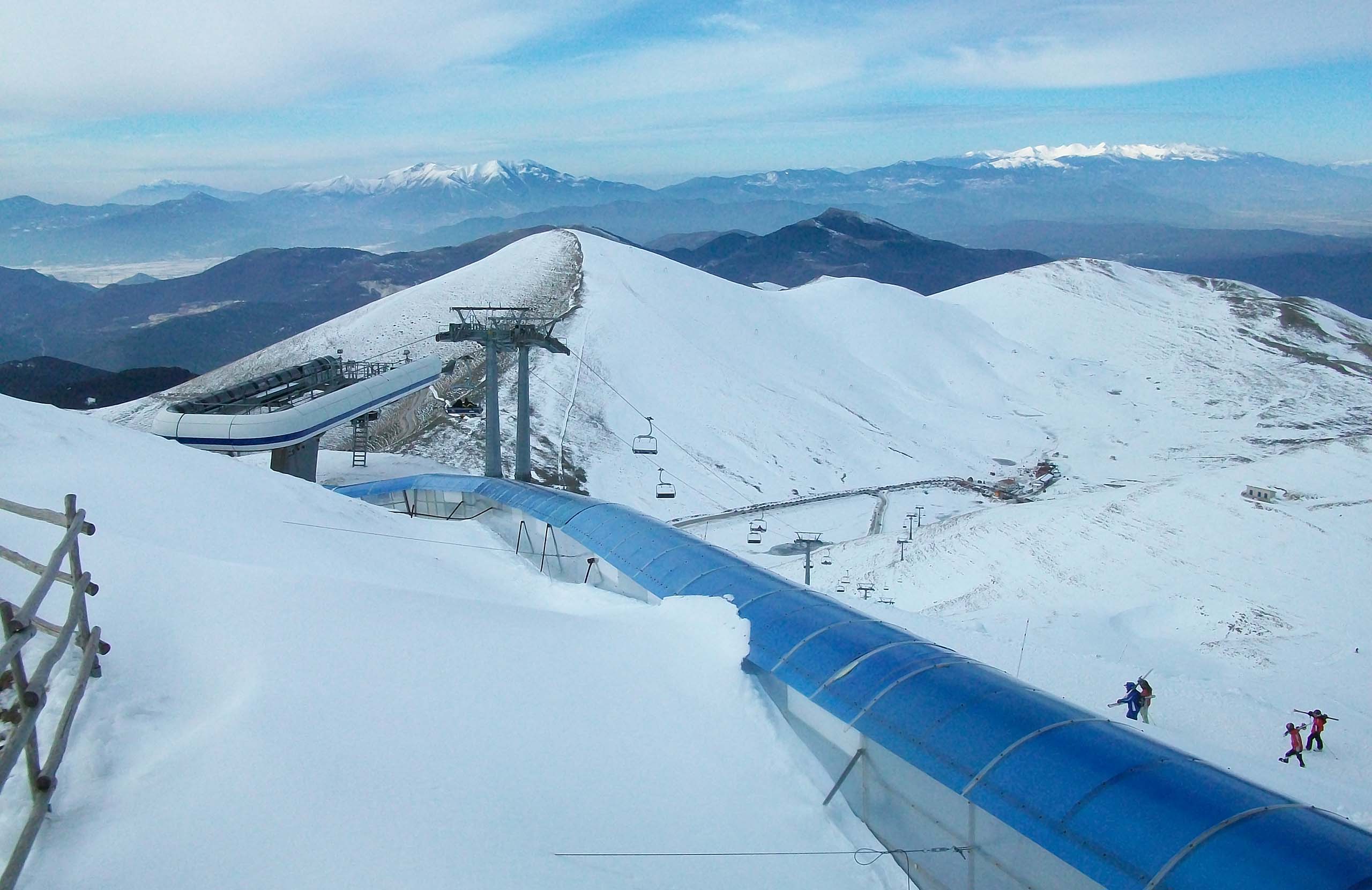
Mount Falakro rises north of the town of Drama, in eastern Macedonia. Its highest peak, Profitis Ilias, is 2,232 metres high. The name means “bald mountain”, because the rounded tops are bare, while forests of beech and pine cover the slopes below. In winter, people come to ski at the ski centre on the plateau of Agio Pnevma. In the warmer months, they come to walk the marked routes and to see the wildflowers of the high meadows. Near the summit is Chionotrypa, a deep natural shaft with ice at the bottom. The mountain villages of Volakas and Granitis are the usual bases. Visitors often combine the mountain with the rest of the Drama area.
Falakro stands in the regional unit of Drama. Its highest peak is Profitis Ilias, at 2,232 metres. A small northern part of the massif crosses the border into Bulgaria. The name means "bald mountain": the tops are rounded and have no trees. Below the main peaks, the plateau of Agio Pnevma lies at about 1,720 metres. On a clear day, the view from there reaches the plain of Drama and the sea. From the northern side of the mountain, you see the valley of the Nestos river.
The mountain is built mostly of marble, in a layer about 1,500 metres thick. Water has cut shafts and caves into it. The best known is Chionotrypa, at about 2,080 metres, close to the summit. It starts as a collapsed shaft about 60 metres deep, with vertical walls and ice at the bottom, and it is more than 100 metres deep in total. The ice stays all year.
Skiing is the main winter activity. The ski centre is on the plateau of Agio Pnevma, about 42 km from the town of Drama. Its base is at about 1,720 metres, and the lifts reach above 2,100 metres. It has about 20 runs and about 20 km of pistes, from beginner slopes to a few difficult ones, with areas for snowboarding.
Hiking takes over when the snow melts. Three coded and marked routes climb from the village of Pyrgoi to the ski centre, and two of them can be joined into a one-day loop. From the ski centre, walkers go on to the summit of Profitis Ilias. Around the village of Granitis, two marked trails of 9 km and 21 km form a network of 30 km. The longer one climbs to the chapel of Agios Pavlos at 1,775 metres.
More than 1,000 kinds of plants grow on Falakro. In late spring and summer, the high meadows are full of wildflowers, among them martagon lilies, peonies and pasque flowers. Several kinds of wild orchid also grow here.
Lower down, beech and black pine forests cover the slopes, with chestnut trees around the village of Granitis. Marked trails cross them. The high ground of the mountain, about 100 square kilometres, belongs to Natura 2000, the European network of protected nature areas.
Volakas, at about 900 metres, is a well-known mountain village near the ski centre. It has guesthouses and tavernas, and the white marble quarried around it is sold around the world.
Granitis, about 30 km north-west of Drama, sits among beech and chestnut forest on the road to the Bulgarian border. A mountain running race starts here every September. Pyrgoi is the village where the marked routes to the ski centre begin.
The Drama area is the starting point, and the ski centre is about 42 km by road from the town of Drama. The road climbs past the village of Volakas to the plateau of Agio Pnevma. Granitis, another base village, is about 30 km north-west of Drama, on the road to the Bulgarian border. A car is the practical way to reach both.
Winter is the ski season, and the dates depend on the snow, so check that the ski centre is open before you travel. Late spring and summer are best for wildflowers and for walking to the summit. Chionotrypa can be visited only in the warm months, and in some years ice blocks the way in. Weekends are busier, because the mountain is close to the cities of northern Greece.
The road to the ski centre can need snow chains in winter. Trail marking is good near the roads and weak higher up, so carry a map or GPS on the long routes. The refuge at the ski centre is the one usually in use, so check in advance where you can stay. Going down into Chionotrypa needs ropes and caving experience, so most walkers only look into it from the edge.