

The archaeological site of Dion lies at the foot of Mount Olympus, in Pieria, in Macedonia. This was the sacred city of the Macedonians, and the mountain above it was the home of their gods.
The sanctuary of Olympian Zeus was the centre of Macedonian religious life. Kings came here to sacrifice before they went to war, and to celebrate when they came back.
At the end of the fifth century BC, King Archelaus established games in honour of Zeus and the Muses — the Olympia at Dion, which lasted several days and included both athletic and dramatic contests. Euripides is said to have staged the Bacchae in the theatre here. Philip II celebrated the destruction of Olynthus at Dion, and his son Alexander made his offerings here before crossing into Asia.
After the Romans defeated the Macedonians at Pydna in 168 BC, Dion became one of their earliest colonies in the region, and it had a second period of wealth under Roman rule. It was abandoned after earthquakes and floods in the fifth century AD.
A site under water
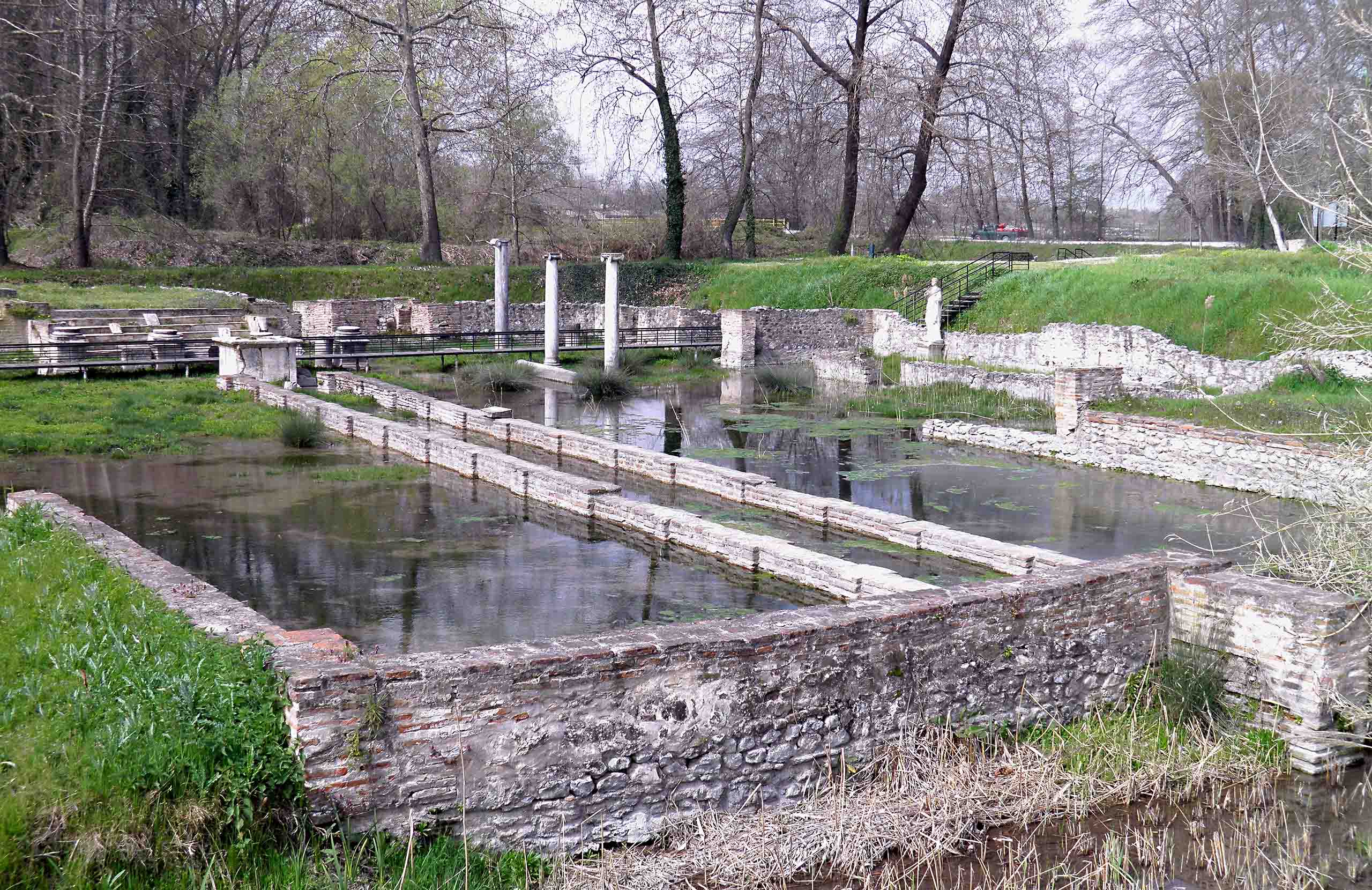
Dion is unusual among Greek archaeological sites because it is wet.
The ground water sits high here, and the river beside the site has flooded parts of it permanently. At the Sanctuary of Isis, water covers the foundations and the bases of the statues, so the temple stands in a still, shallow pool with Olympus rising behind it. It is the image most people take away.
The water also preserved things that would not have survived anywhere else.
What to see
The city walls run for more than two and a half kilometres, and the main paved street crosses the whole site.
Inside are the sanctuaries of Zeus Hypsistos, Demeter, Isis and Asclepius; two theatres, one Hellenistic on a low hill and one Roman of the second century AD; an odeon that probably also served as a council chamber; the Roman agora, shops and workshops; ten separate bath complexes, of which one is very large; and two early Christian basilicas.
The Villa of Dionysus produced the mosaic floor that is now the centrepiece of the museum.
The museum
The Archaeological Museum of Dion opened in 1983, a few minutes from the site in the modern village. It holds the finds from the excavations, arranged by where they were found, with material from Olympus, ancient Pydna and other sites in Pieria on the upper floor.
Its single most remarkable object has a room to itself: the hydraulis, a water organ of the first century BC, found in 1992 in ground that had been drained a few years earlier. It is the oldest instrument of its kind found anywhere in the world. It was the first keyboard instrument, and the church organ of western Europe descends from it.
Where to Stay
Prices shown per night for a sample 3-night stay. Rates and availability vary by season — select your dates for live pricing.
Practical information
Getting there
Dion is about 85 km south of Thessaloniki, roughly an hour by car on the motorway, and about 5 km from Litochoro. There is a signposted exit from the Athens–Thessaloniki motorway.
Public transport is limited. A city bus from Katerini runs to the village and stops at the museum. Without a car, Katerini or Litochoro is the practical base.
Tickets and hours
The site and the museum keep different hours and close on different days. This catches people out. Both change between a summer and a winter timetable, and last admission is twenty minutes before closing.
Check the current hours for each of them separately before you go, and plan the order of your visit around whichever has the shorter day. There is an entrance fee, with the usual reduced and free categories.
How to visit
Allow two to three hours for the site and the museum together.
The site is large and flat, and walking it properly is a couple of kilometres. Paths are gravel and grass, and some sections are damp.
Doing the site first and the museum afterwards works better — the mosaic and the sculpture make more sense once you have seen the buildings they came from.
Good to know
Take insect repellent. The standing water means mosquitoes, particularly in the late afternoon and in the warmer months.
Wear shoes you do not mind getting wet or muddy. Parts of the site hold water after rain, and the ground near the Sanctuary of Isis is always damp.
There is little shade across most of the site.
In summer the Hellenistic theatre is one of the venues of the Olympus Festival, so there may be performances in the evening and some areas may be closed during the day for preparation.
Dion Archaeological Site— been there?Tell others what you saw.
A photo and two lines are enough.
